
 Link label

Kratom for Motivation in 2026: What the Evidence Really Says
Does kratom reliably improve motivation, or can online anecdotes make the answer sound clearer than it is? If you’re researching kratom for motivation 2026, start with this: personal reports and strain names aren’t proof of a predictable effect. Research is limited, and a product label can’t guarantee how a particular batch will affect someone.
It’s understandable to look for a straightforward answer when claims online are confident and sometimes contradictory. This article separates reported experiences from what research can actually establish, explains why names such as “Green” or “Maeng Da” shouldn’t be treated as promises, and offers practical ways to assess product details and sourcing claims.
Canadian shoppers also need to understand the regulatory context: Health Canada has not authorized kratom products for sale for human consumption. We’ll cover what sourcing, processing, freshness and batch-testing information can tell you, and where those details have limits. The goal is to help you assess claims carefully and make an informed decision, without treating kratom as a proven solution for motivation.
Key Takeaways
- “Motivation” is a broad everyday term, not a guaranteed kratom effect or a product specification.
- When assessing kratom for motivation 2026, distinguish personal reports from research that can establish a reliable effect.
- Treat Green, White, and Red labels as product descriptions, not promises about motivation or chemical composition.
- Check sourcing, batch details, and what testing covers, and consult current official Canadian information when regulatory questions matter.
- Canuck Kratom is a Canadian-owned online retailer; its stated farmer relationships and drying methods offer product context, not a promise of effects.
Kratom for motivation: what does the phrase actually mean?
It’s fair to wonder whether kratom might make it easier to get going, stay focused, or feel more energetic. But motivation is not a guaranteed or established effect of kratom. The phrase kratom for motivation 2026 describes a question people are asking, not a proven outcome or a product category with a defined performance standard.
Motivation is an everyday word for the willingness or drive to start and continue an activity. It can mean different things to different people, and it isn’t a single clinical measure. Focus and energy may be part of what someone means, but those terms aren’t interchangeable, either. A person can feel alert without feeling motivated, or feel motivated without experiencing a change in energy.
A motivation claim describes an expectation or personal report; an established finding requires credible evidence that supports a consistent effect. That distinction helps keep marketing language and individual experiences in perspective.
Why people search for kratom and motivation
Most readers are asking an everyday question: could kratom relate to feeling more driven, focused, or alert? Online accounts may shape what people expect, but an anecdote tells you what one person says they experienced. It can’t show that the same outcome is dependable for other people, or that kratom caused it.
For background on the plant, Mitragyna speciosa is the botanical name for kratom. A general overview can help explain what the plant is, but it isn’t evidence that kratom reliably changes motivation. Keep those questions separate as you read.
What a motivation claim can and cannot tell you
A label or strain name can identify how a product is presented, but it doesn’t establish what you’ll feel or provide a verified measure of its chemical profile. The same caution applies to words such as “focus” or “energy” in promotional copy. Ask what information supports the claim, and whether it refers to research, a product detail, or simply an individual’s account.
This section is about education and product literacy, not diagnosis or individualized advice. The rest of this guide looks at what research can and can’t tell us, how to assess strain labels and product information, and what Canadian shoppers should check before making an informed decision. Keep curiosity, claims, and evidence in separate lanes.
What does research say about kratom, motivation, focus, and energy?
The evidence doesn’t establish kratom as a reliable way to increase motivation. Research on focus or alertness can offer context, but those outcomes aren’t the same as motivation, and reported experiences don’t prove a predictable effect.
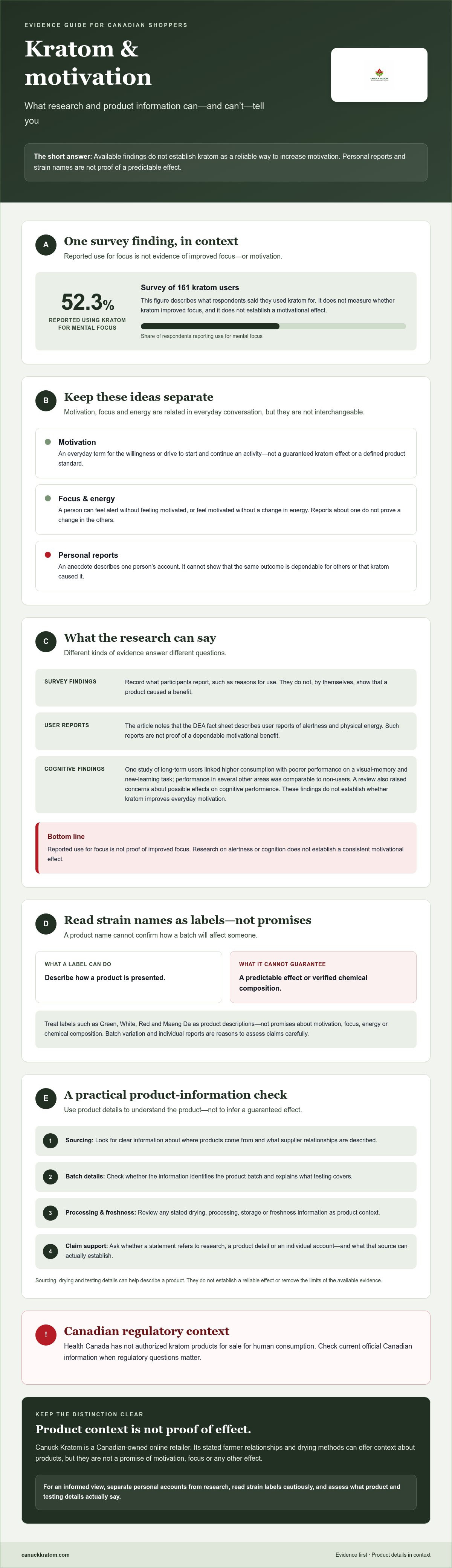
A 2025 survey of 161 kratom users found that 52.3% reported using it for mental focus. That tells us what respondents said they used kratom for, not whether it improved focus or motivation. The Drug Enforcement Administration’s DEA Drug Fact Sheet describes stimulant-like effects at low doses, including user reports of alertness and physical energy. Such reports aren’t proof of a dependable motivational benefit.
Other findings call for care in interpreting claims. A 2018 study of long-term users linked higher consumption with poorer performance on one visual memory and new-learning task, while performance in several other areas was comparable to non-users. A December 2024 review concluded that kratom, including its main alkaloid mitragynine, may adversely affect cognitive performance. These findings address cognition, not whether kratom improves everyday drive.
How to tell stronger evidence from personal reports
Study design matters. A controlled human study can test a question under planned conditions, while a survey records what participants report, and laboratory research may not predict people’s real-world experiences. Case reports and online anecdotes can raise questions, but can’t establish a general effect. Sample size, who took part, how outcomes were measured, and whether independent studies reproduce a result all affect how much confidence it deserves.
Evidence summary: As of the 2025 survey and research published through December 2024, people have reported using kratom for focus, but available findings don’t establish a consistent motivational effect. Survey responses describe reported use; cognitive studies raise separate questions and don’t prove either a motivational benefit or its absence.
Why results and experiences may differ
One person’s account can’t predict another’s experience. Reports may reflect different circumstances, expectations, or products. A strain name alone can’t confirm a product’s composition, and variation between batches can limit broad claims about what a named strain will do. Even testing information needs context: check which product and batch it covers, and what the test measures.
These evidence gaps leave certainty limited. They don’t confirm a benefit, and they don’t prove that no effect is possible. For Canadian shoppers, the practical next step is to separate research findings from claims and check product information carefully. If you’re comparing labels, you can review kratom powder product information as part of that process, without treating a product description as evidence of an effect.
Do kratom strain names predict motivation or product effects?
A name can help you identify how a product is labelled. It can’t tell you exactly how it will affect you. Green, White, and Red are product categories, not standardized measures of motivation, potency, or chemical composition. The same caution applies to strain names such as Maeng Da: the label alone doesn’t confirm a predictable personal outcome.
What Green, White, and Red labels mean for a shopper
Think of colour and strain names as naming conventions, not guarantees. A Green label doesn’t establish that a product will increase focus, just as a Red or White label can’t confirm a particular effect or alkaloid profile. Product and batch details need to be assessed on their own. Don’t use a label as a substitute for evidence about the specific item you’re considering.
Promotional language may sound precise, but ask what it actually establishes. The table below separates a description from conclusions it can’t support on its own.
| Claim presented | What it establishes | What remains unconfirmed |
|---|---|---|
| “Green” or “White” kratom | The product is presented under that label. | A specific effect, motivation level, or chemical profile. |
| “Maeng Da” on the product name | The seller uses that strain name to describe the product. | That it will produce a particular experience or outcome. |
| “Batch-tested” in a description | A testing process is being claimed. | Which batch was tested, what was measured, and the actual results. |
How to read a kratom product profile
Look for concrete details, not just an appealing name. Check whether the seller explains sourcing, kratom processing, drying, freshness, and storage. If testing is mentioned, ask whether results apply to the specific batch and what they cover. Contamination testing looks for unwanted substances; alkaloid testing measures or identifies alkaloids. Neither should be assumed unless the product information confirms it.
If you’re comparing Green or White Maeng Da descriptions, the article Premium Maeng Da Kratom: The Canadian Buyer’s Guide for 2026 is a relevant place to learn more about the product category. Read any guide alongside current, item-specific details. For kratom for motivation 2026, the practical takeaway is simple: compare verifiable product information, not promised outcomes. Batch variation means a label or general description can’t guarantee consistency from one product or batch to another.
How can Canadian shoppers assess kratom claims responsibly?
Use a simple rule: separate claims about effects from information you can check. A natural origin doesn’t establish safety, suitability, or a predictable response. Nor does buying a particular product prove it can resolve low motivation. This checklist can help you assess what a seller says before making an informed decision.
- Look for the source behind the claim. Is it based on a clearly described study, a survey, an individual account, or promotional copy? Each supports a different level of confidence.
- Check who was studied and what was measured. A finding about alertness, for example, doesn’t automatically establish an effect on motivation. Consider whether the study population and outcome are relevant to the claim.
- Ask whether a finding has been repeated. One report or study can raise a question, but independent replication can help show whether a result holds beyond one setting. Treat guarantees and vague potency language cautiously.
- Review product and batch details. Look for specific, current information about sourcing, kratom processing, freshness, and storage. A strain label alone can’t verify composition or expected effects.
- Clarify what testing covers. A statement about testing is not the same as seeing results. Check whether information is batch-specific, which tests were done, and whether they cover contaminants, alkaloids, or both. The guide “Vendor Secrets: Why Lab Tested Kratom is Non-Negotiable” is a relevant resource for understanding testing claims.
- Check current Canadian information. If regulatory status affects your decision, consult Health Canada’s current information directly. As of September 2026, the research brief for this article reports that Health Canada has not authorized kratom products for sale for human consumption. Verify the current position rather than relying on seller claims or old posts.
For kratom for motivation 2026, a careful decision starts with realistic expectations. The checklist can help you judge the quality of a claim, but it can’t predict an individual response or remove uncertainty. Product details and testing information also have limits, especially when they don’t identify the specific batch or explain the scope of the tests.
If you’re comparing products, review the available kratom product information and assess its sourcing and testing details for yourself. Clear information can support a more informed purchase, but it should never be read as a promise of motivation, safety, or a specific effect.
Where does Canuck Kratom fit in an evidence-first decision?
After weighing research and marketing claims, the next step is to assess the seller’s product information on its own terms. Canuck Kratom is a Canadian-owned online retailer offering kratom powder, including Green, Red, and White Maeng Da categories. It isn’t a motivation solution, and a product description can’t establish a personal effect.
What Canuck Kratom product information can help you assess
The company describes sourcing from experienced farmers and suppliers in Southeast Asia, and says its team has spent over eight years building relationships with farmers. It also describes kratom leaves as naturally dried using controlled methods. These details can help you understand the stated sourcing and processing approach, but they don’t guarantee a particular composition or outcome.
For any product you’re considering, read its product profile and check what information is available about sourcing, processing, freshness, and storage. Testing claims need the same careful review. Canuck Kratom states that it offers laboratory-tested botanical products, but availability and scope should be confirmed for the specific product and batch. Check what was tested and whether results are available; don’t assume a general statement applies to every item.
For more background on powder descriptions and Canadian shopping considerations, see Pure and Potent: The Ultimate Kratom Powder Sale in Canada Guide [2026]. Treat a guide as general context, then check current product details before making a decision.
A practical next step for curious Canadian shoppers
Browsing a product page can help you compare disclosed information. It doesn’t establish a medical or motivational benefit, and it can’t remove uncertainty about how a product may vary between batches. Compare the details that are actually provided: sourcing, freshness, storage, processing, and product-specific testing disclosures. If information is unclear or isn’t available, take that limitation into account rather than filling the gap with a strain name or a broad quality claim.
If you’re researching kratom for motivation 2026, keep the goal focused on informed product assessment, not an expected boost in drive or performance. When you’re ready, explore Canuck Kratom online and review the available product information at your own pace.
Make your next decision with clear information
The evidence doesn’t establish kratom as a dependable way to improve motivation. Personal reports and research on focus or alertness can provide context, but they don’t guarantee an outcome. And Green, White, or Red labels can’t predict your individual experience or confirm a product’s chemical profile.
For kratom for motivation 2026, the practical takeaway is to judge claims by their evidence and product details. Check sourcing, freshness, storage, batch information, and what any stated testing actually covers. Keep uncertainty in view, and consult current official Canadian information if regulatory questions affect your decision.
Canuck Kratom is a Canadian-owned online botanical retailer serving customers nationwide. The business states that it works with experienced farmers and suppliers and focuses on sourcing and quality information. Explore the available product details, without treating them as a promise of motivation or performance: Explore Canuck Kratom online.
A careful, informed choice starts with asking good questions. Keep doing that as you compare your options.
Frequently Asked Questions
Does kratom increase motivation?
There’s no established evidence that kratom reliably increases motivation. Some people report changes in alertness or focus, but personal accounts don’t prove a consistent effect. The phrase kratom for motivation 2026 describes a popular question, not a proven benefit. Motivation is also broad: feeling alert, for example, doesn’t necessarily mean feeling more willing or able to start a task.
Can kratom help with focus or energy?
Some users report changes in focus or energy, but those reports don’t establish that kratom reliably produces either effect. A 2025 survey recorded users’ reasons for use, while research on cognition has its own limitations and does not prove a motivational benefit. Alertness, focus, energy, and motivation are different outcomes. Treat claims about them as claims to assess, not results to expect.
What is the best kratom strain for motivation?
No kratom strain has been established as the best choice for motivation. Names and colour labels such as Green, White, and Red identify how products are presented, but they don’t guarantee an effect, potency, or chemical profile. If you’re comparing products, review the specific product and batch information rather than choosing based on a promised outcome or online ranking.
Do White Maeng Da or Green Maeng Da guarantee more energy?
No. White Maeng Da and Green Maeng Da are product names, not guarantees of extra energy or a predictable experience. A name alone doesn’t verify a product’s composition, and products can vary by batch. Check the seller’s product information for sourcing, processing, and any testing details that apply to the specific item. Treat effect claims cautiously, even when they’re attached to a familiar strain name.
Is kratom approved in Canada as a treatment for low motivation?
No. Health Canada has not authorized products containing kratom for sale for human consumption, and kratom is not an approved treatment for low motivation. The research brief reports that no kratom product has a Natural Product Number. Check current Health Canada information if regulatory status matters to your decision, and don’t treat a product description or strain label as evidence of approval or therapeutic benefit.
How can I evaluate kratom quality claims in Canada?
Look for clear, current details about sourcing, kratom processing, freshness, storage, and the product batch. If a seller mentions testing, check whether results are available, which batch they cover, and what was tested, such as contaminants or alkaloids. A general statement that a product is tested doesn’t tell you the results or scope. Also treat “natural” as an origin description, not proof of safety or suitability.
What should I do if motivation concerns are affecting daily life?
If motivation is affecting your daily routine, note which tasks or situations feel harder and whether there are patterns in when this happens. Don’t assume a kratom product addresses the cause, or use a strain label to explain what you’re experiencing. This article can help you assess product claims and evidence, but it can’t determine why motivation has changed or predict how a product may affect you.