
 Link label

What Is Kava? A Clear Guide to the Traditional Pacific Drink
What if kava in a modern extract isn’t the same as the traditional Pacific drink? If you’ve been asking “what is kava,” that distinction is a useful place to start. Kava can refer to a plant and to preparations made from its root, while commercial products may include concentrated extracts with their own product information.
It’s reasonable to want a plain-language explanation before exploring kava, especially when labels and formats can be confusing. This guide covers kava’s place in Pacific traditions, how the root is traditionally prepared with water, and what the term kavalactones means. It also explains how traditional preparations differ from commercial extracts, which shouldn’t be assumed interchangeable.
For Canadian shoppers, product details matter. We’ll outline what to check, including whether a product carries a Natural Product Number (NPN), what its ingredients are, and what safety warnings it provides. Kava products have been associated with a potential risk of liver injury, so “natural” shouldn’t replace careful label reading. By the end, you’ll have a clearer foundation for assessing product information and making an informed choice.
Key Takeaways
- Learn what is kava by distinguishing the Pacific plant from the traditional drink made from its root or rhizome.
- See how preparation and sharing practices can vary among Pacific Island communities.
- Understand what kavalactones are and why traditional beverages, dried plant material, and extracts shouldn’t be assumed interchangeable.
- Check Canadian product labels for a Natural Product Number and review the ingredients, product information, and safety warnings.
- Use a simple decision path to assess a product without treating traditional use or natural origin as proof of safety or specific effects.
What Is Kava? Meet the Plant Behind the Traditional Drink
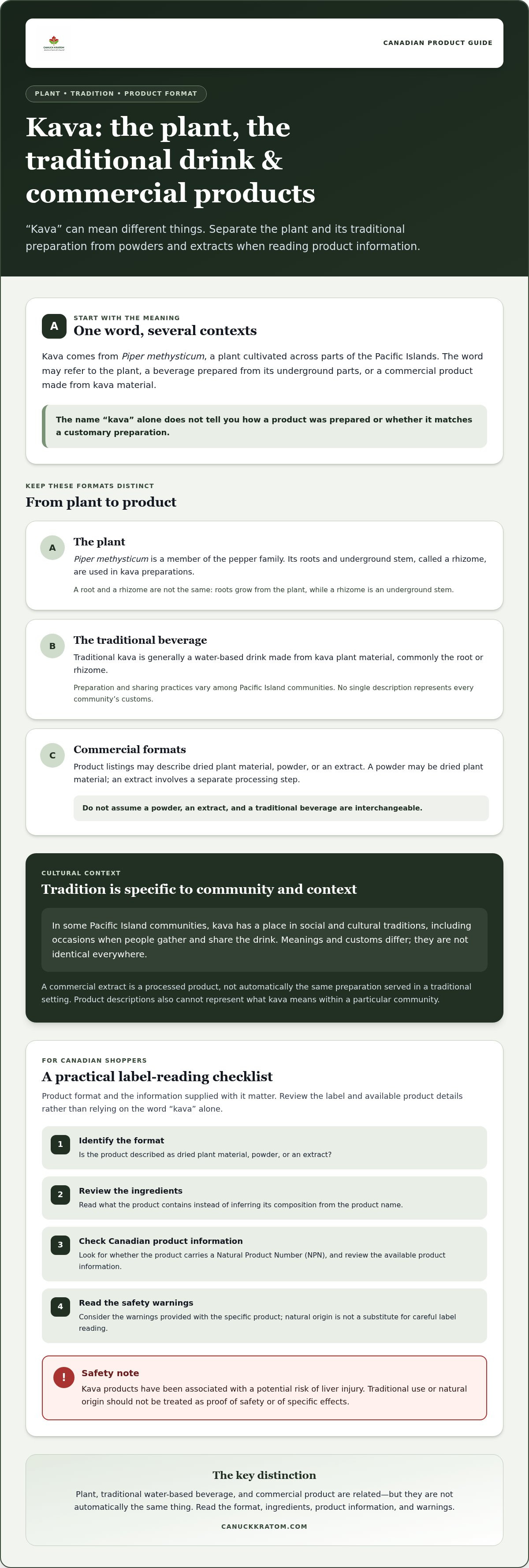
Kava comes from Piper methysticum, a plant cultivated across parts of the Pacific Islands. Its root and underground stem are used to make a traditional beverage. That’s the plain-language answer to “what is kava,” but the word can mean more than one thing. Depending on the context, it may refer to the plant, the drink prepared from it, or a commercial product made from kava material.
Keeping those meanings separate helps. A traditional drink has a preparation and cultural context; a powder or extract is a product format. The label “kava” alone doesn’t tell you how a product was made or whether it matches a customary preparation.
What plant does kava come from?
Piper methysticum is a member of the pepper family, grown in Pacific Island settings where kava has distinct cultural histories and uses. Customs differ among communities, so it’s better not to treat the region as if it had one shared tradition. For general botanical background, Kava (Piper methysticum) offers an overview of the plant and its history.
The drink is commonly prepared from the plant’s underground parts, described as roots or rhizomes. They aren’t the same: roots grow from the plant, while a rhizome is an underground stem. Both terms appear in descriptions of kava, so noting the plant part can make product information clearer.
What does “kava” mean in everyday use?
In everyday conversation, “kava” might mean the plant itself or the water-based beverage made from its root or rhizome. In product listings, it can also refer to dried plant material, powder, or an extract. These formats aren’t automatically equivalent to one another or to a traditionally prepared drink.
For example, a powder may be a form of dried plant material, while an extract is made through a separate processing step. The format, ingredients, and product details matter. Don’t assume a product’s name alone describes its preparation or composition. For Canadian shoppers, reading the available label and product information is a practical first step when comparing commercial products with the traditional drink.
How Traditional Kava Is Prepared and Shared
Traditional kava is generally a water-based beverage made from kava plant material, commonly the root or rhizome. The plant material is prepared with water to make a drink. This broad description is more reliable than treating one method as universal. Practices can differ between Pacific Island communities, so a short overview can’t stand in for the knowledge and customs of the people who maintain those traditions.
What is the traditional kava drink made from?
The basic distinction is straightforward: traditional kava is a beverage prepared from plant material and water. That differs from a commercial extract, which is a processed product rather than the same preparation served in a traditional setting. Powders and extracts can also differ from one another, so the word “kava” on a label doesn’t tell you exactly how a product was made.
There’s no recipe here, and that’s intentional. If you’re looking for practical preparation instructions, consult a dedicated kava tea guide that clearly explains its source and scope. For a scientific overview of kava chemistry and regulatory context, the U.S. Drug Enforcement Administration’s DEA Drug & Chemical Evaluation is a separate reference, not a guide to Pacific Island cultural practices.
Why does kava have cultural significance?
In some Pacific Island communities, kava has a place in social and cultural traditions, including occasions when people gather and share the drink. Its meaning and associated customs aren’t identical everywhere. They can vary by community and context, so it’s more respectful to describe kava as part of diverse traditions than to assign one set of rules or meanings to all Pacific Islanders.
That context also helps separate cultural interest from assumptions about a commercial product. A concentrated extract isn’t automatically a traditional beverage, and a product label can’t tell you what kava means within a particular community. Canuck Kratom lists kava and kava extract products; review the available product details rather than assuming an extract matches customary preparation.
Kavalactones, Kava Drinks, and Extracts: What Is the Difference?
To understand what is kava in a product listing, separate two questions: what form is it in, and what does the available information say about its composition? A traditional drink, dried plant material, and an extract are different formats. The word “kava” alone doesn’t make them equivalent.
What are kavalactones?
Kavalactones are a group of naturally occurring compounds associated with kava. The term names compounds found in the plant; it isn’t, by itself, a measure of a product’s strength or a prediction of how someone will respond. To understand a specific product’s stated kavalactone content, look for clear, product-specific information rather than relying on a general description or name.
Product format describes what a product is; it doesn’t establish evidence about outcomes. For health and safety context, the U.S. National Center for Complementary and Integrative Health provides NCCIH Kava Safety Information.
How do traditional drinks and extracts differ?
A traditional beverage is generally water-based and prepared from kava plant material. Dried material is a product form, while an extract is made by processing plant material into a concentrated product. Those descriptions tell you about format, not whether two products have the same composition. An extract shouldn’t be assumed equivalent to a traditional drink.
Use this comparison as a starting point, then check the details available for the specific product:
| Format | What the term tells you | What to check |
|---|---|---|
| Traditional beverage | A water-based preparation from kava plant material | Preparation and cultural context can vary |
| Dried plant material | Kava material in dried form | Plant part and any preparation details provided |
| Extract | A processed commercial format | Ingredients and product-specific composition information |
Canuck Kratom lists Kava Kava 5X Extract and Kava Kava 3x 40 percent kavalactone. These names identify commercial offerings, but they don’t establish that either matches a traditional beverage. Read the available product information carefully, and don’t infer composition or comparable characteristics from an extract ratio or product name alone.
Kava Safety and Canadian Product Information to Check
Natural origin doesn’t mean risk-free. If you’re exploring what is kava, include safety and product information in your research, not just tradition or format. Health Canada warns of a potential risk of liver injury associated with kava products. Reports of harm don’t mean every product has the same risk, but they make careful label reading and credible sources essential.
What safety questions should readers consider?
Safety evidence has limits, and product forms may differ. The U.S. National Center for Complementary and Integrative Health summarizes reported concerns, including rare cases of severe liver injury, in its kava safety information. Read such sources for the scope and limitations of the evidence, rather than treating them as proof that a particular product is safe or unsafe.
Check current Health Canada information for Canadian warnings and regulatory context, since guidance can change. If you have questions about how kava could relate to your health or other products you take, speak with a qualified health professional. This article can help you assess information, but it can’t provide personal medical advice.
What should Canadian shoppers check on a kava product?
Before deciding, review the label and product information. Look for details that explain what the product is and what it contains. If information is missing or unclear, don’t fill in the gaps by guessing.
- Product form: Is it dried plant material, a traditional-style preparation, or an extract?
- Ingredients: Does the label clearly identify the contents?
- Testing information: Is testing described, and does the information say what was tested? Don’t assume testing is available if it isn’t stated.
- Canadian product details: Check Health Canada’s current information. If a product claims to be a licensed natural health product, look for its Natural Product Number (NPN) and verify the specific product through Health Canada. Don’t assume a listing or product name proves licensing.
- Warnings and directions: Read all label cautions and directions; don’t treat a general description as a substitute.
Canuck Kratom lists kava and kava extract products. Review the product information provided before drawing conclusions about a specific listing. To see the available products, explore Canuck Kratom online.
How to Explore Kava Without Confusing Tradition and Product Claims
Once you understand what is kava, keep cultural knowledge and product claims separate. Learning about Pacific Island traditions can offer valuable context, but it can’t tell you how a particular commercial product was prepared or what to expect from it. A label can describe a product; it can’t guarantee personal effects or health outcomes.
Use this decision path before making a choice:
- Learn the form. Is the listing describing material intended for a drink, a powder, or an extract? Don’t assume one format is interchangeable with another.
- Read the label. Check the ingredients and the product details actually provided. Note what’s missing, too.
- Check the evidence. Look for credible sources that support specific safety or health claims. A confident product description isn’t evidence on its own.
- Then decide. If key information is unclear, pause rather than filling in the gaps with assumptions.
Which questions should you ask before choosing a product?
Ask what the product is, how its contents are described, and whether the seller provides information about testing. If a listing makes claims about potency, safety, or health outcomes, look for reliable evidence that applies to that specific claim and product. A format name or extract ratio alone doesn’t establish composition, quality, or how a person may respond.
Keep cultural interest distinct from personal expectations. Traditions vary, and learning about them doesn’t predict an individual experience. If you’re searching for preparation instructions, look for a dedicated kava tea guide when one is available. This article explains the distinction between traditional preparations and commercial products; it isn’t a recipe.
Where can Canadian readers learn more?
For current Canadian regulatory information, consult Health Canada directly. Check the source date and make sure any guidance applies to the specific kind of product you’re researching. Don’t treat a retailer’s description as a substitute for current official information.
Canuck Kratom is a Canadian-owned online botanical retailer that lists kava and kava extract offerings. Review the information provided for each product and ask questions rather than assuming a commercial extract matches a traditional preparation. You can browse the offerings through the retailer’s online store.
Explore Kava With a Clearer Perspective
Now you have a practical answer to “what is kava”: it can mean the Pacific plant, a traditional water-based drink made from its root or rhizome, or a commercial product. Those forms aren’t automatically interchangeable. Kavalactones are compounds associated with kava, but a product name or extract ratio alone can’t tell you everything about its composition or what to expect.
Keep curiosity grounded in clear information. Separate cultural learning from product claims, read labels closely, and check current Canadian guidance and relevant safety information. Natural origin isn’t a guarantee of safety, and unclear details are a reason to pause and look for better information.
Canuck Kratom is a Canadian-owned online retailer serving customers across Canada. Its product list includes kava kava and two named kava extract offerings. Review the available details without assuming an extract matches a traditional preparation, then explore Canuck Kratom’s online botanical offerings.
Frequently Asked Questions
What is kava made from?
Kava is made from the root or rhizome of Piper methysticum, a plant from the Pacific Islands. Traditional kava is generally a water-based beverage prepared from this plant material. Commercial products may instead be dried material, powder, or extract, so the word “kava” doesn’t describe one single preparation. Check the product form and ingredients to understand what a particular listing contains.
Is kava the same as kava kava?
Yes. “Kava” and “kava kava” are commonly used names for the same plant and the products made from it. The terms don’t tell you whether a listing refers to the plant, a traditional beverage, dried material, or an extract. Read the product description and label for those details. A shared name doesn’t mean different products have identical ingredients or composition.
How is traditional kava different from kava extract?
Traditional kava is generally a water-based drink prepared from plant material, while an extract is a commercial product made by processing kava material. They aren’t automatically equivalent. For example, Canuck Kratom lists Kava Kava 5X Extract and Kava Kava 3x 40 percent kavalactone. Those names identify product formats, but don’t by themselves establish composition or comparable characteristics. Check the product-specific information provided.
What are kavalactones in kava?
Kavalactones are a group of compounds naturally associated with kava. The term identifies compounds, not a guarantee of a product’s strength or a prediction of its effects. If you want to know how much a particular product contains, look for clear, product-specific information. Don’t assume that an extract ratio, product name, or general description establishes its exact composition.
Is kava legal in Canada?
Kava products can be sold in Canada as licensed natural health products. Health Canada’s current information says licensed products carry an eight-digit Natural Product Number (NPN), which you can check against the specific product in Health Canada’s Licensed Natural Health Products Database. Don’t assume that every kava listing is licensed or that a product name alone confirms its regulatory status. Check current official information before purchasing.
Can kava interact with medications or other substances?
Kava may pose safety concerns alongside some substances, and Health Canada identifies alcohol use as a factor that may increase concern about liver injury. The possible risks depend on the product and individual circumstances; this FAQ can’t assess personal interactions. If you take medication, use alcohol, have a health condition, or have questions about kava, speak with a qualified health professional and consult current Health Canada safety information.
What should I check before buying kava in Canada?
Check whether the listing is for a drink ingredient, dried material, powder, or extract, then review its ingredients, label warnings, and any testing details the seller actually provides. If it’s presented as a licensed natural health product, look for its NPN and verify that number in Health Canada’s database. Don’t treat natural origin, a product name, or an unsupported safety or potency claim as proof of quality.