
 Link label

Is Kratom Legal in Canada? What Shoppers Need to Know 2026
What if the answer to “is kratom legal in Canada” depends on whether you’re possessing it, buying it, or bringing it across the border? That distinction is easy to miss when online claims make the rules sound like a simple yes or no.
As of October 2026, kratom isn’t listed as a controlled substance under Canada’s Controlled Drugs and Substances Act. That doesn’t mean every product or sale is authorized. Health Canada hasn’t authorized kratom for human consumption, so a product’s claims and how it is marketed matter. Importing raises different questions from personal possession, and an international order may face scrutiny at the border.
This guide explains the legal questions Canadian shoppers should consider, including the difference between possession and sale, what to check about product authorization, and where import rules fit in. We’ll point you to official sources such as Health Canada, the Justice Laws website, and the Canada Border Services Agency (CBSA), so you can check current requirements instead of relying on a seller’s assurances or conflicting online posts.
Key Takeaways
- The answer to “is kratom legal in Canada” can depend on the product and activity. Don’t treat online availability as proof of Canadian authorization.
- Check how Health Canada classifies the exact product and whether it has the required authorization for its stated use.
- Buying, selling, advertising, importing, and possessing kratom raise separate questions. Verify each one against current official information.
- Before deciding, note the product’s ingredients, intended use, and any claims made about it.
- If the rules remain unclear or your decision has legal consequences, consult official sources or qualified legal counsel.
Is kratom legal in Canada? Start with the distinction that matters
The short answer is that it depends on the product and the activity. The question “is kratom legal in Canada” might refer to possession, sale, advertising, importing, or authorization for a particular use. These are separate issues, so a single yes-or-no answer can be misleading.
As of October 2026, kratom isn’t listed as a controlled substance under the federal Controlled Drugs and Substances Act, according to its current schedules. That doesn’t establish that a specific product is authorized for sale as a health product or for human consumption. Check the current Justice Laws text for controlled-substance status and Health Canada information for product authorization. For import questions, consult current CBSA and Health Canada guidance.
What does “legal” mean for a kratom product?
Controlled-substance scheduling and product authorization answer different questions. The first concerns whether a substance is listed under the federal controlled-drugs framework. The second concerns whether a product meets the rules for its category, intended use, and claims. A Natural Product Number is an eight-digit number carried by licensed natural health products in Canada. Don’t assume a kratom product has one. Check the exact product in Health Canada’s official resources.
Kratom, also known as kratom (Mitragyna speciosa), is a plant, but a botanical description alone doesn’t settle how a product is regulated. Its ingredients, presentation, and claims can all matter.
Why online availability is not a legal answer
A product listing shows that a seller offers it. It doesn’t, by itself, show that Health Canada has authorized the product for a particular use. A seller’s description also isn’t a substitute for regulator records or published guidance. Compare the exact product details and claims with current Health Canada information rather than relying on a listing alone.
A product being available online does not mean it has Canadian regulatory authorization.
Keep the activities separate as you research. Possession, selling, advertising, and importing each call for their own check. This section is educational, not legal advice. Rules and official guidance can change, so confirm current information before acting. If your decision has legal consequences or the rules remain unclear, consult qualified legal counsel.
How Canadian product rules may apply to kratom
Canadian product rules consider more than a plant’s name. Health Canada assesses and authorizes regulated health products before they can be marketed in Canada. The rules can depend on how a product is classified, its intended use, and the claims made about it. To answer “is kratom legal in Canada,” check the specific product and how it is presented, not just its ingredients or whether it’s sold online.
The Food and Drugs Act and the Natural Health Products Regulations are relevant when a product is presented as a natural health product. In that context, Health Canada’s product-licensing process assesses information submitted for the product, which must be licensed before it can be sold as an NHP. A product described as a botanical specimen, for example, shouldn’t automatically be treated as an authorized health product. Assess the wording and intended use in context.
Health Canada authorization and the Natural Product Number
A Natural Product Number is an eight-digit number identifying a natural health product licensed by Health Canada. It applies to the specific licensed product, not every item from a seller or every product with similar ingredients. Check the exact product in Health Canada’s official product-licensing database and review current notices. As of October 2026, the information available for this guide indicates that no kratom product has been issued an NPN. Health Canada’s advisory identifies seized kratom products as unauthorized. Don’t treat that notice as proof of a different product’s status without checking it.
Controlled-substance rules are a separate question
The Controlled Drugs and Substances Act and its schedules address whether a substance is controlled under that legislation. Check the current Justice Laws text rather than relying on an older summary. A substance’s status on a controlled-substance list doesn’t, by itself, establish whether a product is authorized under food or natural health product rules. If the legal effect is unclear, ask a qualified Canadian legal professional.
For shoppers, keep the checks distinct: identify the exact product, its stated purpose, the claims used to market it, and any authorization shown in official records. Retailer information can help you understand what’s offered, but it can’t confirm government approval. You can review Canuck Kratom’s product information for product details, while checking regulatory status separately with Health Canada.
Buying, selling, importing, and possessing kratom are not the same
For Canadian shoppers, “is kratom legal in Canada” can mean several different things. A product on a Canadian website doesn’t prove that Health Canada has authorized it, and the status of one activity doesn’t settle the rules for another. Use the table as a starting point, then check current official information for your situation.
| Activity | What to check |
|---|---|
| Buying | A listing isn’t proof of product authorization. Check Health Canada’s current notices and product information for the exact item. The legal treatment of a particular purchase may need case-specific verification. |
| Selling | Health Canada says kratom products aren’t authorized for sale for human consumption. The rules may depend on the product’s classification and intended use. |
| Advertising | Claims can affect how a product is regulated. Health Canada states that selling kratom with health claims violates the Food and Drugs Act. Check current guidance before relying on a seller’s wording. |
| Importing | Confirm current requirements with the CBSA and Health Canada. These agencies have authority to stop or seize shipments. Check official guidance for the product and shipment before ordering internationally. |
| Possessing | As of October 2026, kratom isn’t listed as a controlled substance under the current federal controlled-substance schedules. That fact alone doesn’t establish whether its sale, marketing, or import is authorized. |
Permission or status in one legal category doesn’t settle the rules in another. Health Canada’s notice about kratom products provides an example of its position on unauthorized products. Read the notice alongside current regulations, not as a blanket answer for every product or activity.
What should Canadian shoppers check before ordering?
Start with the exact product, its ingredients, intended use, and any claims on the listing or label. Then check current Health Canada notices and authorization information. If the order would cross an international border, consult current CBSA and Health Canada guidance rather than assuming a shipment will be permitted. For information about domestic delivery, see kratom shipping within Canada. Delivery information doesn’t establish regulatory authorization.
What should sellers and advertisers verify?
Sellers should review how a product is classified and how its intended use and marketing claims may affect that classification. Third-party testing, sourcing details, and retailer assurances may inform product quality, but they aren’t proof of government authorization. Business-specific questions call for current official guidance and, where legal consequences matter, advice from a qualified Canadian legal professional.
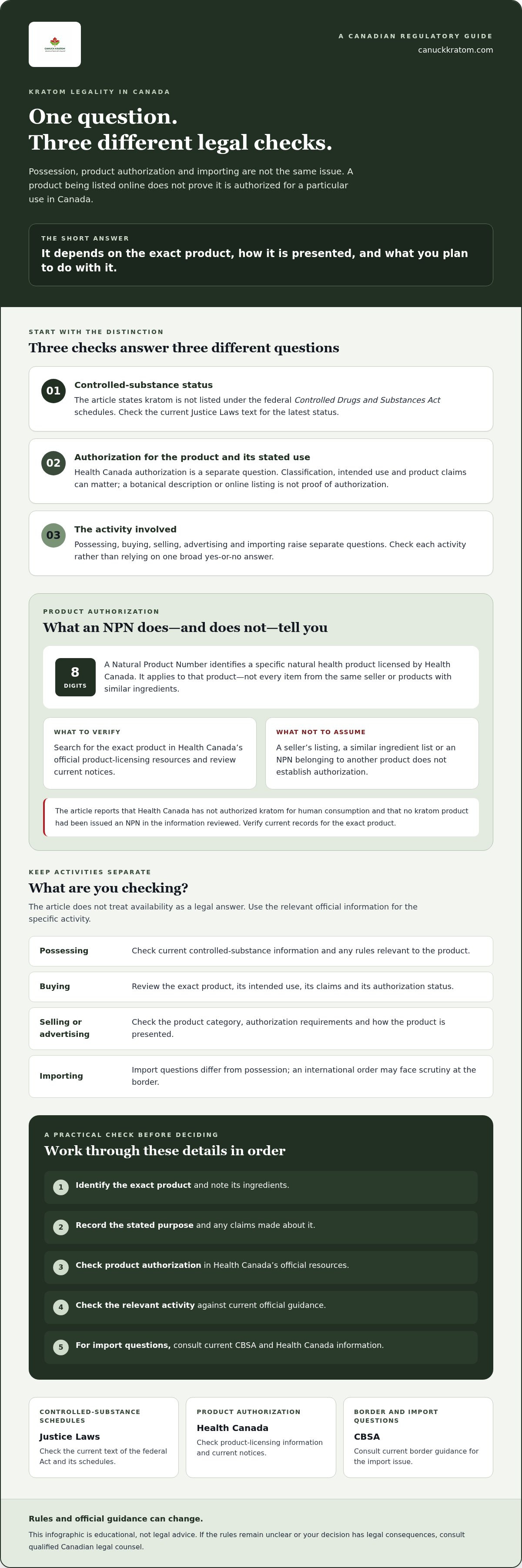
A practical checklist for checking kratom rules in Canada
Before deciding, pin down what you’re checking. “Is kratom legal in Canada” can involve product authorization, how a product is marketed, or a specific activity such as importing. Keep those questions separate and use current official information rather than relying on a broad assurance from a retailer.
- Identify the exact product. Record its name, ingredients, form, intended use, and the claims shown on its label or product page.
- Check Health Canada’s information. Search its product-licensing resources and current notices for authorization details. Confirm that any result matches the exact product, not just a similar ingredient or brand.
- Check the relevant activity. Product rules and requirements for buying, selling, advertising, possessing, or importing aren’t interchangeable. For federal legislation and controlled-substance schedules, consult the current Justice Laws text. For an international shipment, check import guidance with the appropriate Canadian authorities, including the CBSA where relevant.
- Assess the seller’s information. Look for clear product details and specific, verifiable statements. Don’t treat a broad “legal in Canada” claim, sourcing information, or third-party testing as proof of government authorization.
- Keep a record. Save the official pages or notices you relied on and note the date you checked them. Recheck before acting if time has passed or the product, claims, or activity have changed.
Which official sources should readers consult?
Start with Health Canada for product authorization information and notices. Use Justice Laws to review current federal legislation and schedules. If your question involves importing, check guidance from the relevant federal authorities rather than assuming domestic and international orders are treated alike. Confirm each source’s role and scope. Don’t use one agency’s information to answer a different legal question.
How to assess a retailer’s claims responsibly
Retailer details can help you assess what’s offered, but they don’t replace regulator records. For background on supplier and quality considerations, read this guide to high quality kratom in Canada. For general criteria to consider when comparing sellers, see the best Canadian kratom site guide. These are retailer resources, not proof of authorization.
To review product details alongside your own checks, explore kratom product information, and confirm regulatory questions with official sources.
What to do if you are still unsure about kratom legality
If you’re still asking “is kratom legal in Canada,” don’t treat a single online answer as decisive. Check three things separately: whether the exact product has the relevant authorization, what activity you’re considering, and what the current rules say. A product’s availability, a seller’s description, and its status under one law don’t settle every other question.
Make your next step specific. For a product question, review current Health Canada notices and product authorization information. For federal legislation or controlled-substance schedules, consult the current Justice Laws text. If your question concerns an international shipment, check current CBSA and Health Canada guidance. Save the pages you reviewed and note the date, so you can tell whether the information is still current when you decide.
When to seek qualified guidance
Some questions need more than a general guide. If you’re considering importing kratom, selling it, advertising it, or making another business decision, consult qualified Canadian legal counsel about the specific facts. Product form, intended use, claims, and the activity involved may all matter. Don’t rely on this article for a personal legal conclusion. For current product and regulatory notices, go directly to the relevant Canadian government sources.
How Canuck Kratom fits into the conversation
Canuck Kratom is a Canadian-owned online retailer, not a regulator or legal adviser. Its product pages can provide information about what the retailer offers, but a listing or stock status doesn’t establish government authorization. Check regulatory questions independently, and seek legal advice if the consequences of your decision could be significant.
Once you’ve checked the rules that apply to your situation, you can explore Canuck Kratom online to review the retailer’s product information. Keep the checks separate, and don’t treat availability as a substitute for authorization.
Make your next kratom decision with confidence
The answer to “is kratom legal in Canada” depends on more than whether a product is listed online. Product authorization, the activity involved, and current rules each need separate checks. A substance’s status under controlled-substance legislation doesn’t establish that a product is authorized for sale or for a particular use.
Before acting, confirm the exact product and its claims using current Health Canada information. Check Justice Laws for federal legislation, and consult the relevant Canadian authority about importing. If your situation has legal consequences, seek advice from a qualified Canadian legal professional rather than relying on a retailer’s assurance.
Canuck Kratom is a privately owned Canadian online botanical retailer offering products to customers across Canada. The company focuses on herbal powders and botanical extracts, but product availability isn’t proof of government authorization. Review Canuck Kratom’s product information after checking the rules that apply to your situation.
Frequently Asked Questions
Is kratom legal in Canada in 2026?
As of October 2026, kratom isn’t listed as a controlled substance under Canada’s Controlled Drugs and Substances Act. That doesn’t settle whether a product is authorized for sale or human consumption. Health Canada hasn’t authorized kratom for human consumption, and product classification and marketing claims matter. The answer to “is kratom legal in Canada” depends on the exact product and activity. Check current Health Canada and Justice Laws information before acting.
Can you buy kratom in Canada?
You may find kratom offered by Canadian retailers, but an online listing doesn’t confirm Health Canada authorization or establish that sale for human consumption is permitted. Health Canada hasn’t authorized kratom for human consumption. Before ordering, identify the exact product and intended use, then review current Health Canada notices. Keep the seller’s activity separate from your own purchase. If the order would cross the border, check current guidance from the CBSA and Health Canada.
Is kratom a controlled substance in Canada?
No. As of October 2026, kratom isn’t listed as a controlled substance under the federal Controlled Drugs and Substances Act. Check the current Act and its schedules on the Justice Laws website in case the rules change. This status answers only one legal question. It doesn’t show that a kratom product is authorized for sale as a food, medicine, or natural health product, or that its marketing claims comply with Canadian requirements.
Can you import kratom into Canada?
Don’t assume an international kratom order will clear the border. The CBSA, working with Health Canada, has authority to stop or seize kratom shipments. The outcome for a particular shipment may depend on its details and applicable requirements, so verify current import guidance with the CBSA and Health Canada before ordering. Information about domestic delivery doesn’t answer whether an international shipment may enter Canada.
Does a Natural Product Number mean kratom is legal in Canada?
A Natural Product Number (NPN) identifies a specific natural health product licensed by Health Canada. It isn’t general approval for every product from a seller or every product with similar ingredients. Check the exact product in Health Canada’s official resources, and don’t rely on an unverified NPN claim. As of October 2026, the information available for this guide indicates that no kratom product has been issued an NPN.
Can a Canadian retailer sell kratom if it is available online?
Online availability alone doesn’t establish that a kratom product is authorized. Health Canada hasn’t authorized kratom for human consumption and says kratom can’t legally be sold as a food, medicine, or natural health product. Health claims can also affect how a product is regulated. Check current Health Canada notices and the product’s intended use and claims. A retailer’s location, sourcing information, or assurances aren’t a substitute for regulatory authorization.
Where can I check the latest kratom rules in Canada?
Start with Health Canada for product authorization information and current notices. Use the Justice Laws website to review the Controlled Drugs and Substances Act and its schedules. For questions about an international shipment, check current CBSA and Health Canada guidance. Match the information to the exact product and activity, and note when you reviewed it. If your decision has legal consequences or the rules are unclear, consult qualified Canadian legal counsel.