
 Link label

Kava Tea: How to Prepare It and Choose the Right Product
What if the right way to prepare kava tea depends less on your favourite recipe and more on what’s in the package? It’s easy to assume every kava product belongs in a cup, but traditional root preparations and concentrated extracts aren’t automatically prepared the same way.
If you’re unsure what “kava tea” means or how to follow unfamiliar preparation terms, start with the product itself. Its form and label directions matter, and a natural ingredient isn’t automatically risk-free.
This guide explains what people mean by kava tea and how preparation can vary by product form. You’ll learn what to check on the label, including ingredients, directions and a Natural Product Number (NPN), which identifies a licensed Natural Health Product in Canada. We’ll also cover practical quality questions, such as whether batch-testing details are available, and why you shouldn’t treat a concentrated extract like traditional kava root. Use the product’s full name and directions to make a more informed choice before preparing a drink.
Key Takeaways
- Kava tea can mean a prepared drink, not one standard product format. Identify what you have before choosing a preparation method.
- Let the product’s full label guide each step, and don’t assume a concentrated extract is intended to be prepared like kava root.
- Compare traditional root, instant formats and extracts by their preparation directions and the product information provided.
- Before choosing kava tea, check the ingredient list, label directions, available testing information and storage guidance.
- Canadian shoppers can review kava product details and confirm shipping information directly with the online retailer.
What Is Kava Tea? Start With the Plant and Product Form
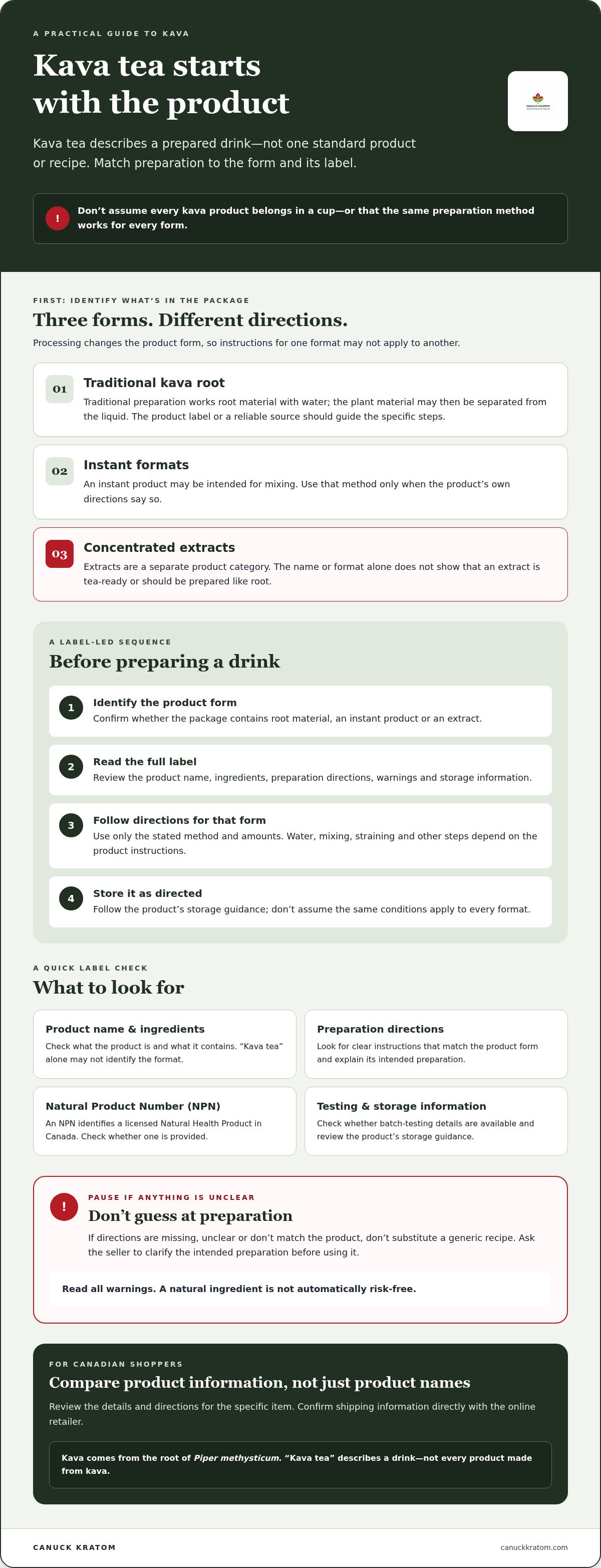
Kava tea is a water-based drink prepared from kava root or a kava product specifically labelled for beverage preparation. The phrase describes a prepared drink, not one standard product or recipe. Traditional root, instant formats and concentrated extracts can have different ingredients and directions, so the preparation method for one form may not apply to another.
Kava comes from the root of Piper methysticum, a plant with a long history of use in Pacific Island communities. For an overview of the plant and its cultural background, see Kava or kava kava (Piper methysticum). For more on the traditional Pacific drink and its context, read our sibling guide, “What Is Kava? A Clear Guide to the Traditional Pacific Drink.”
What does kava tea usually mean?
In traditional preparation, kava root is worked with water to make a drink; the plant material may then be separated from the liquid. That describes the general idea, not a complete recipe. The right steps depend on the specific product, so don’t apply a method or quantity unless its label or a reliable source supports it.
Product terms aren’t always used consistently. One seller may use “kava tea” for a drink made from root, while another may use the phrase more loosely for a product intended to be mixed into a beverage. Check the full product name, ingredient list and preparation directions rather than relying on the word “tea” alone.
Kava root, instant products, and extracts are not interchangeable
Processing changes the product form, and the form can change how it’s prepared. Traditional root material may call for a preparation process described on its label. An instant product may be made to mix or dissolve, but only follow that method if its directions say so. Concentrated extracts are a separate category. Their format or strength alone doesn’t show that they’re suitable for a cup of tea.
Canuck Kratom lists kava kava and extract products, including Kava Kava 5X Extract and Kava Kava 3x 40 percent kavalactone. Those names identify offerings, not preparation instructions. Don’t assume an extract is tea-ready. Check its label and product information first, and ask the retailer for clarification if the intended preparation isn’t clear.
The practical distinction is simple: the plant is the source, but “kava tea” describes a drink, not every product made from kava. Identify the form and confirm its intended use before deciding how to prepare it.
How to Make Kava Tea: Follow the Product Label Step by Step
There isn’t one reliable recipe for every kava product. Root material, instant formats and concentrated extracts may have different intended uses, so start with the product in front of you, not a generic online recipe. Label directions take priority over generic recipes.
Check the product form and its preparation directions
Before preparing anything, read the full label, including the ingredients, directions, warnings and storage information. Look for wording that clearly explains whether the product is intended for traditional preparation, instant mixing or another use. Don’t assume an extract can be prepared like root material just because it contains kava.
Check that the directions match the product form and explain the preparation clearly. If instructions are missing, unclear or don’t match the product, don’t guess. Ask the seller to clarify the intended preparation before using it. A product name alone may not tell you whether it belongs in a drink.
Prepare, strain, and serve only as directed
Use this label-led sequence to keep the process clear:
- Identify the form. Confirm whether you have root material, an instant product or an extract.
- Follow the directions for that form. Use only the stated preparation method and amounts. Water, mixing, straining and any other steps depend on the product’s instructions.
- Check before serving. Make sure you haven’t substituted a generic recipe for the product’s directions. If the label doesn’t explain how to prepare it, stop and seek clarification.
- Store it as directed. Follow the product’s storage guidance rather than assuming the same conditions apply to every format.
This is especially important with concentrated products. The National Center for Complementary and Integrative Health notes that kava has been linked to rare cases of liver injury. Read all warnings and don’t treat a plant-based product as risk-free.
For Canadian shoppers comparing formats, review Canuck Kratom’s kava product information and check the directions for the specific item. Clear instructions help you decide whether a product suits the preparation you have in mind.
Kava Tea Ingredients and Methods: Match the Process to the Product
The product form is your starting point. Traditional root, instant formats and concentrated extracts aren’t interchangeable, and a method suited to one may not apply to another. Use the table as a label-reading guide, not as a recipe or a claim that every format is available from one retailer.
| Product form | Preparation suitability | What to check on the label |
|---|---|---|
| Traditional root | May call for a preparation process that includes working the root with water and separating the plant material. Follow the product’s directions. | Confirm the intended method, ingredients, any straining directions and storage guidance. |
| Instant format | May be intended for mixing, but don’t assume it dissolves or prepares in a particular way. | Look for explicit mixing directions, amounts and any instructions about water or serving. |
| Concentrated extract | Don’t treat it as traditional root material or assume it’s suitable for brewing. | Check the intended use, full directions, ingredients and warnings. Ask the seller if anything is unclear. |
Traditional root preparation versus instant kava
Traditional root preparation may involve steps that an instant product doesn’t require. An instant format may have its own mixing directions, but the label must confirm that. There’s no universal rule for water, straining or other preparation details across these forms. Product descriptions can use terms differently, so check the instructions on the item you actually have rather than borrowing a method from another format.
When the product is an extract
A concentrated extract is processed differently from root material, so its name or format alone can’t tell you how to prepare it. Don’t invent a dilution or serving method. Check the intended use and follow verified label guidance. If the directions don’t clearly cover beverage preparation, ask the seller before proceeding.
The U.S. Drug Enforcement Administration describes kavalactones as pharmacologically active kavalactones. That background doesn’t replace product-specific directions or establish that an extract is intended for a drink. For more on extract formats and what to review before purchasing, see “Kava Kava Extract Canada: A Practical Buying Guide.”
Before choosing a method, check whether the label names the product form, explains how it should be prepared and gives enough information to follow the directions without guessing. If not, pause and seek clarification. That’s a better starting point than treating every kava tea product as the same.
Kava Tea Safety and Storage: What to Check Before Preparing a Cup
Kava’s natural origin doesn’t establish that a product is risk-free. Health Canada has warned about potential liver risks associated with kava, and the National Center for Complementary and Integrative Health notes that kava has been linked to rare cases of liver injury. Health Canada also advises against combining kava with alcohol. Read the product’s warnings and use information before deciding whether it’s appropriate for you.
For Canadian shoppers, check the label for a Natural Product Number (NPN), which identifies a licensed natural health product. An NPN is useful product information, not a reason to ignore warnings or assume there’s no risk. If you have questions about health risks or interactions, speak with a qualified health professional.
Read quality and testing information carefully
Start with the basics: does the package clearly identify the product and list its ingredients, directions and warnings? Then look for testing information. The phrase batch-tested quality control should mean that the seller confirms testing for the specific batch, not simply that testing may occur in general. If the seller doesn’t say what was tested or whether results apply to the batch you’re considering, ask for clarification.
Testing claims are product-specific. A laboratory-testing statement made by one retailer isn’t evidence that another retailer’s products have been tested. Don’t assume testing is available unless the seller provides details, and don’t treat a test claim as a substitute for a clear label or appropriate licensing information.
Store kava products and handle concerns responsibly
Storage needs can vary by product. Follow the package instructions for storage and use after opening; don’t assume every form needs refrigeration or has the same shelf life. Keep the original packaging so you can refer back to its ingredients, batch details, warnings and directions.
Follow the product’s storage instructions and keep its packaging information. That simple habit helps you retain the details you may need to review later. If the directions are missing, damaged or unclear, contact the seller before using the product. For health or interaction questions, ask a qualified health professional rather than relying on a product description or a general recipe.
Before preparing kava tea, confirm the product identity, read its complete label and review any available batch-testing details. You can review Canuck Kratom’s kava product information, then check the specific item’s label for directions, warnings and storage guidance.
Choosing Kava Tea Products in Canada: Your Practical Next Steps
Make your decision based on clear product information, not a familiar name or a general recipe. For Canadian shoppers, confirm what the item is, how it’s intended to be prepared and what the seller can verify. Use this checklist before choosing a product for kava tea.
A Canadian shopper’s kava tea checklist
- Confirm the product form. Check the exact product name and whether it’s root material, an instant format or an extract. Don’t choose a preparation method until you know what form you have.
- Verify intended preparation. Look for directions that clearly describe how the specific product is meant to be used. If the label doesn’t say it’s for beverage preparation, don’t assume it belongs in a cup.
- Read the complete label. Review the ingredients, directions, warnings and any information about use after opening. If details are missing or unclear, ask the retailer before proceeding.
- Review testing information. Look for a clear explanation of whether testing is available and what it covers. Don’t treat a general quality statement as confirmation that your specific batch was tested.
- Check storage and product status. Follow the package’s storage guidance. If you expect a Natural Product Number (NPN), verify it on the product label and check the number rather than assuming a product has one.
Explore Canuck Kratom’s confirmed kava offerings
Canuck Kratom is a Canada-wide online retailer with confirmed kava offerings that include Kava Kava, Kava Kava 5X Extract and Kava Kava 3x 40 percent kavalactone. These names identify the listed offerings, but they don’t confirm that each one is suitable for tea preparation. Check the specific item’s directions and product details before choosing a preparation method.
Before ordering, Canadian shoppers should verify current product information and shipping details directly with the online retailer. This can help clarify questions about the format, label, available testing information or delivery to your area.
Review Canuck Kratom’s kava product information before choosing. The specific item’s details can help you decide whether it matches what you’re looking for, without guessing how it should be prepared.
Choose Your Kava Product With Confidence
Good kava tea preparation starts with the product form, not a one-size-fits-all recipe. Traditional root, instant formats and concentrated extracts can have different preparation needs, so check the full label and follow its directions. Review ingredients, warnings, available testing information and storage guidance before preparing a cup. Natural origin alone doesn’t mean a product is risk-free.
Canuck Kratom is a Canadian-owned online retailer serving customers across Canada. Its confirmed kava offerings include Kava Kava, Kava Kava 5X Extract and Kava Kava 3x 40 percent kavalactone. These product names don’t confirm that each item is intended for tea preparation, so verify the specific product details and instructions before choosing.
To compare the available information, explore Canuck Kratom’s kava product information and review the details at your own pace. Check the item’s label and directions before deciding how to prepare it.
Frequently Asked Questions
What is kava tea?
Kava tea is a drink prepared from the root of the kava plant, Piper methysticum, or from a kava product whose label specifically describes beverage preparation. The term doesn’t refer to one universal product or recipe. Traditional root, instant formats and concentrated extracts are different forms, and their preparation directions may differ. Check the exact product and its label before treating it as tea material.
How do you make kava tea?
Start by identifying the product form and reading its full label. Follow the stated directions for ingredients, water, mixing and straining, if applicable. Traditional root preparation may involve working the root with water and separating the plant material, but don’t use generic quantities or timing in place of product instructions. If directions are missing or unclear, ask the seller to clarify before preparing the product.
Can you make kava tea with kava extract?
Only if the specific extract’s label clearly describes preparation as a beverage. An extract isn’t automatically interchangeable with traditional root, and its name or concentration doesn’t establish how it should be used. Don’t guess at dilution, amounts or serving directions. Read the complete label and contact the seller if the intended use isn’t clear. Follow product-specific directions rather than adapting a root-preparation recipe.
What does kava tea taste like?
Traditional kava drinks are often described as earthy and somewhat bitter, though flavour can vary with the product and preparation. That description won’t necessarily apply to instant products or extracts, which may have different ingredients or directions. Check the product information for any stated flavour details, and avoid assuming that a particular form or product name guarantees a specific taste. Preparation should still follow the label.
Is kava tea safe to drink?
Kava isn’t risk-free simply because it comes from a plant. Health Canada has raised concerns about potential liver risks, and the National Center for Complementary and Integrative Health reports rare cases of liver injury associated with kava. Health Canada advises against combining kava with alcohol. Read all warnings, verify product information, and speak with a qualified health professional about health or interaction questions.
How should kava tea or kava products be stored?
Follow the storage and after-opening directions on the specific product’s label. Storage guidance can differ by form, so don’t assume every product needs refrigeration or has the same shelf life. Keep the original packaging and retain its ingredients, warnings, batch details and preparation directions for reference. If storage information is missing or unclear, ask the seller rather than relying on assumptions.
Does Canuck Kratom sell kava tea?
Canuck Kratom’s confirmed offerings include Kava Kava, Kava Kava 5X Extract and Kava Kava 3x 40 percent kavalactone. The available information doesn’t confirm that these products are tea-ready or that each is intended for beverage preparation. Check the specific product’s directions and details before choosing a method. Canuck Kratom is a Canadian-owned online retailer serving customers across Canada.