
 Link label

Kratom Powder Tea Preparation: A Clear, Responsible How-To
What is the most important thing to understand about kratom powder tea preparation? Online recipes describe ways to handle the powder in liquid, but those directions should not be mistaken for a recommendation to drink it. Recipes can also leave out practical details about mixing, texture and flavour. This guide explains those details while keeping the safety distinction clear.
Kratom powder tends to settle and has a naturally bitter taste. Health Canada has not authorized kratom products for consumption and warns against swallowing or inhaling kratom. Preparing powder as tea does not change that guidance.
Below, you’ll find an overview of commonly described preparation stages, differences in texture and flavour, and details Canadian shoppers can review when choosing powder, such as sourcing and freshness. Strain labels do not guarantee a particular potency or chemical profile, so use product information to make a cautious, informed choice.
Key Takeaways
- Kratom powder suspends in liquid rather than fully dissolving, so expect some texture and settling.
- This kratom powder tea preparation guide describes common stages without prescribing quantities, temperatures or steeping times.
- Stirred, steeped and strained approaches differ in texture and effort. Compare them based on practical preferences, not promised results.
- Clean, dry tools and consistent handling can make the process easier to describe and repeat. Secure storage helps protect the powder’s condition.
- Clear information about sourcing, processing and freshness can help Canadian shoppers make a more informed powder choice.
Kratom Powder Tea Preparation: What to Know Before You Start
Kratom powder is ground leaf. Kratom powder tea refers to powder placed in liquid, not a beverage in which the powder fully dissolves. Fine particles may remain suspended briefly or collect at the bottom. Understanding that difference helps set expectations about texture without confusing preparation details with claims about personal outcomes.
Kratom comes from Mitragyna speciosa, a tree native to Southeast Asia. For broader botanical background, see the overview of Mitragyna speciosa (Kratom). Preparation describes what happens when ground leaf is handled in liquid. It does not establish what someone may experience. This guide does not provide medical advice, treatment claims or promised effects. Keep descriptions of the process separate from assumptions about results.
What changes when kratom powder is prepared as tea?
Liquid makes powder easier to stir or filter, but it does not turn ground leaf into a fully dissolved ingredient. Some particles may remain visible or settle if the mixture stands. Filtering can remove some visible solids, depending on the tool, but it changes the texture, not the identity of the product.
People use “tea” to describe this way of handling powder in liquid. The word refers to the preparation format, not a guaranteed product profile or experience. Strain names and preparation choices are not proof of a particular chemical composition. Treat descriptions of appearance and handling as just that: descriptions.
What should you gather before preparing kratom tea?
For an organized work area, set out the items you need on a clean, uncluttered surface before opening the package. Commonly described equipment includes:
- Water
- A suitable heat-safe vessel
- A stirring utensil
- An optional strainer, if you want to separate some visible particles
Clean equipment and a clear surface make handling easier to repeat and describe. Read the product’s information before handling it and follow its directions. Online recipes may include details that do not apply to every product, so do not assume they provide product-specific guidance. This overview does not set powder amounts, serving sizes, water temperatures or steeping times.
How to Prepare Kratom Powder Tea Step by Step
Online recipes can make kratom tea preparation sound standardized, even when they leave out whether their details apply to a particular product. This guide does not provide a drink recipe or directions for consumption. It can help you recognize the stages commonly described as tea preparation and understand why unsupported details should not be treated as reliable instructions.
In general terms, recipes may describe heating water, combining it with powder, stirring, optionally allowing it to steep, and filtering if desired. This is a description of commonly named stages, not a recommendation to carry them out or a promise about the result.
How do you mix kratom powder into hot water?
Recipes commonly describe adding powder to heated water and stirring to combine. Stirring is a physical mixing action; it does not establish a specific product profile or predict what someone will experience. Do not treat a particular technique as validated guidance unless a credible source supports its details for the product in question.
The U.S. Drug Enforcement Administration’s kratom fact sheet discusses kratom and forms of use, including tea. It provides U.S. context, not Canadian product instructions. A source describing a method does not make that method a recommendation. Check where guidance comes from and what it actually supports instead of filling gaps in a recipe with assumptions.
When and how can you strain kratom tea?
Some descriptions include filtering as an optional final stage. A fine-mesh strainer or suitable filter may be mentioned, but this guide does not give instructions for filtering a drink for consumption. The filter alone cannot establish safety, potency or a predictable result. A smoother-looking preparation is not proof of any of those things.
For non-consumptive handling, prioritize the product’s own directions and a clean, organized work area. Keep tools and the package managed carefully, and avoid creating airborne dust or spills. If a recipe gives an exact amount, temperature or steeping duration without explaining its source, do not assume that detail is suitable for every product. Product-specific handling guidance is the appropriate reference for the material you have.
The key distinction is between a method description and verified instructions. “Heat, combine, stir, steep, filter” names stages found in some recipes; it does not establish that a drink is safe or that a particular approach is appropriate for a specific powder. Read sources critically, and do not interpret a brewing sequence as an endorsement to consume kratom.
Kratom Tea Methods Compared: Texture, Flavour, and Practical Choices
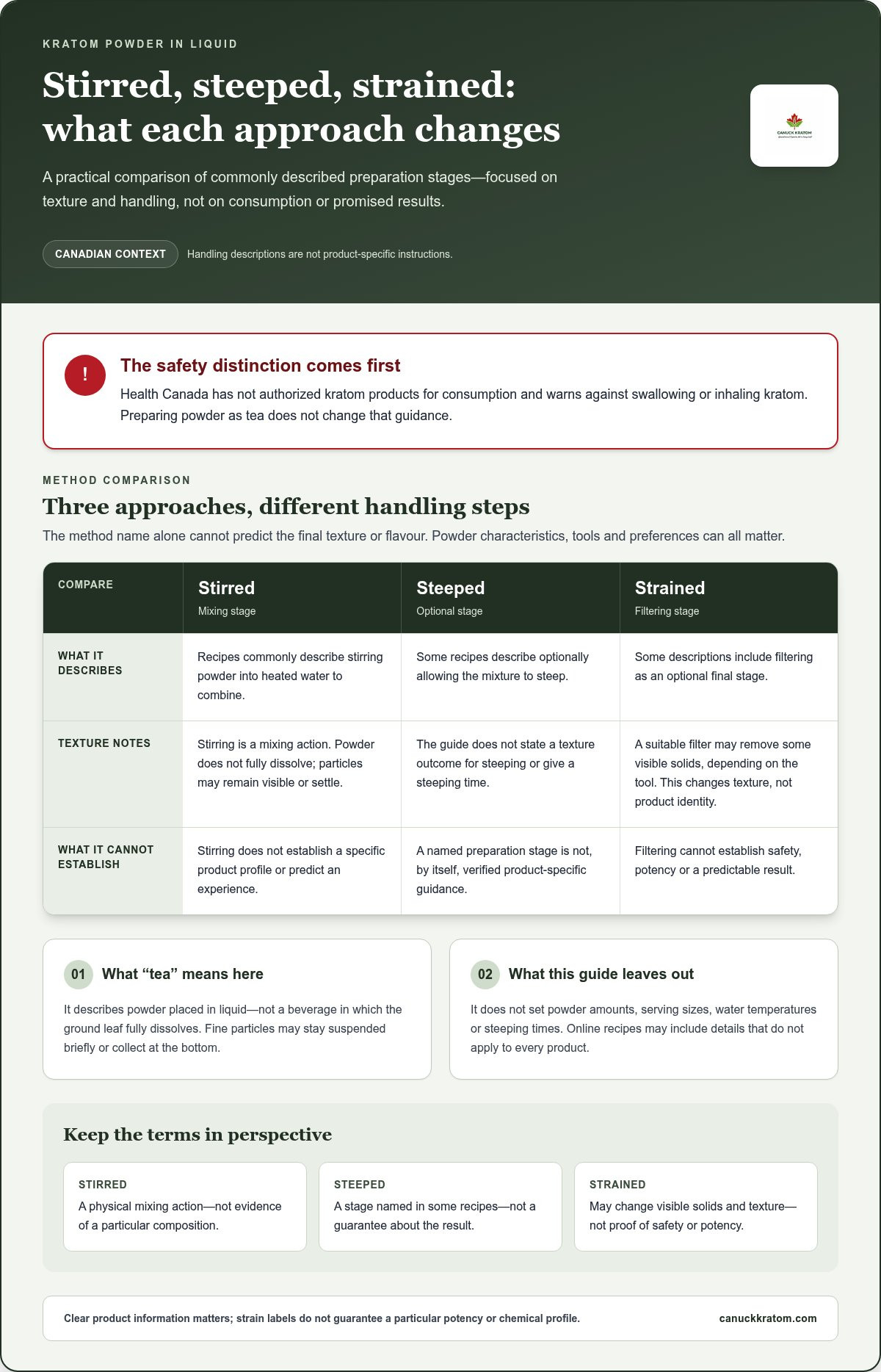
Stirred, steeped and strained are labels for different preparation approaches, but the method name alone cannot predict the final texture or flavour. Powder characteristics, the tools used and personal preferences all matter. This comparison focuses on practical differences, not guaranteed results, and is not a recommendation to make or drink kratom tea.
Use the table to compare what each approach involves. “Texture” describes a general preference, not a promise about how a particular powder will turn out. Effort refers to the handling steps, not to an effect.
| Approach | Texture preference | Effort involved |
|---|---|---|
| Stirred | Keeps the mixture in its original form, which some may prefer over filtering. | Involves fewer tools and steps. |
| Steeped | Texture can vary; the label alone doesn’t show what the finished mixture will feel like. | Adds a waiting stage to the process. |
| Strained | May suit someone who prefers a different mouthfeel, though results depend on the filter and material. | Requires an additional tool and cleanup. |
Should you strain kratom powder tea or leave the particles in?
That depends on personal texture preference, not on a guaranteed change in quality or experience. Someone comparing approaches might note whether they prefer a preparation with more powder retained or one passed through a filter. The filter’s design and the powder’s characteristics affect what remains, so “strained” does not mean a uniform result.
To compare preparation descriptions fairly, change one factor at a time and record the tool or method being discussed. That helps distinguish a preference from a claim about the product. Do not infer chemical composition or a predictable outcome from the feel of a mixture.
How can you make the flavour easier to approach?
Flavour is personal. When discussing taste as a culinary matter, describe your preference rather than claiming an ingredient will reliably cover another flavour. For example, someone might choose a spice-forward or herbal profile in an ordinary beverage because they enjoy it. That choice says nothing about kratom quality or effects, and an added ingredient should not be presented as a safety measure.
Keep observations clear by noting the product description and any flavour additions separately. Product labels do not promise a fixed flavour or chemical profile, and a preferred taste is not evidence of a particular result. With kratom powder tea preparation, practical comparisons are about texture and flavour preferences, not a method that guarantees an outcome.
Keep Kratom Tea Preparation Consistent and Handle Powder Carefully
Repeatable handling starts with simple habits: use clean, dry equipment, keep the work area clear, and follow the same approach to opening and closing the package. If you are comparing powder appearance or texture for informational purposes, note the product information and handling steps involved. This can make observations easier to describe, but it does not make kratom suitable for drinking.
Health Canada warns against swallowing or inhaling kratom. Natural origin does not mean a product is risk-free, and consistent handling cannot remove that concern. Product quality checks can provide information about a batch, but they cannot guarantee safety or a particular outcome. Keep that distinction in mind when reviewing product details.
How should kratom powder be stored between preparations?
Follow the storage and handling guidance on the product packaging. As a general handling practice, keep the powder sealed and dry, and avoid leaving the package open while you work. Use clean, dry hands or tools, then close the package securely. These steps help protect the product’s condition; they do not establish a shelf life, guarantee freshness or make the product safe to consume.
- Keep the package closed when you are not handling the powder.
- Use dry tools and avoid introducing moisture into the package.
- Follow any storage directions provided with the product rather than assuming a specific temperature or time limit.
What product information helps you prepare more consistently?
Before handling a product, review its identity and any available information about sourcing, kratom processing and testing. Check that the product description matches the package, and read any batch or handling details provided. Testing information can vary in scope and availability, so do not assume every product has been tested for the same substances or characteristics. Look for specific details rather than relying on a broad quality claim.
Strain or colour labels can help identify how a product is presented, but they do not guarantee a fixed chemical composition or potency. Natural materials can also vary between batches. If the packaging provides batch information, keep it with your notes when comparing product descriptions or appearance. That supports accurate record-keeping, not predictions about effects.
For Canadian shoppers, transparency means understanding what a product is, how it has been sourced and processed, and what testing information is available. Canuck Kratom sources from experienced farmers and trusted suppliers in Southeast Asia, with leaves dried using controlled methods. These details can inform product selection, but they are not a safety guarantee or an endorsement for consumption.
Review the available details before choosing a product, then explore Canuck Kratom’s kratom powder options for sourcing and product information. Handle powder consistently, store it according to its packaging, and do not treat preparation habits or quality checks as proof of safety.
Choose Kratom Powder with Clear Information Before Making Tea
A responsible powder choice starts with the information behind the label, not assumptions about how a product will feel in liquid. Sourcing, processing, freshness, batch details and available testing information can help you understand what you are considering. They do not establish that kratom is safe to consume, and preparation guidance should not be read as an endorsement to make or drink tea.
Use product descriptions to answer practical questions: What is the product identified as? Where is it sourced? How are the leaves processed? What does the seller say about storage and the batch? Clear answers make comparisons more grounded. If details vary between products or batches, that variation should be stated plainly rather than obscured by broad claims of consistency.
What sourcing and processing details can Canadian shoppers review?
Look for information about supplier relationships and how leaves are handled after harvesting. Canuck Kratom sources from experienced farmers and trusted suppliers in Southeast Asia, with leaves naturally dried using controlled methods. These details explain the supply chain and processing approach; they do not guarantee a particular potency, chemical composition or product profile.
Consider freshness alongside the product’s packaging and storage guidance, rather than treating a general claim as a promise. Testing details also need context: available information may differ by product or batch. A clear description should state what testing information is available without implying that every powder has the same testing, composition or batch characteristics.
How can Canuck Kratom support an informed powder choice?
Canuck Kratom’s powder selection includes Green Maeng Da Kratom, Red Maeng Da Kratom and White Maeng Da Kratom. These are product labels, not guarantees of potency or chemical makeup. Read the information for the specific powder you are considering, including its sourcing, processing and any available batch details. That gives you a more useful basis for comparison than relying on a name alone.
Canuck Kratom ships from inventory stocked in Canada to customers across the country and reports maintaining fresh inventory. These details describe the shopping and fulfilment context; they are not assurances about an individual batch or a recommendation to consume kratom.
Keep one boundary in view: kratom powder tea preparation describes handling powder in liquid, but it does not change the product’s status or establish that drinking it is safe. In Canada, Health Canada warns against swallowing or inhaling kratom. Make purchasing decisions with that context in mind, and treat product information as a way to understand what is offered, not as a promise of results.
If you are comparing powders as a Canadian shopper, explore Canuck Kratom’s kratom powder selection and review the available product information before deciding what suits your preferences.
Make Your Next Choice an Informed One
Let clear information, not the promise of a perfect cup, guide your next step. Kratom powder tea preparation describes how powder may be handled in liquid; it cannot establish that drinking kratom is safe or predict what someone will experience. Keep that distinction in mind as you assess product descriptions and decide what information matters to you.
Before acting on a recipe or strain label, check what the product information actually says. Be wary of claims that turn a preparation method into a guarantee, and do not fill gaps with assumptions. A careful, informed choice starts with what can be stated plainly.
Ready to review powder options and product information? Explore Canuck Kratom powder online, compare the details and make your next decision with care.
Frequently Asked Questions
Does kratom powder dissolve completely in tea?
No. Kratom powder may leave particles visible in liquid or settle at the bottom, so a clear-looking mixture does not prove that everything dissolved. Stirring and filtering can change what you see, but appearance cannot confirm strength, safety or chemical composition. Product labels do not guarantee a fixed profile either. Health Canada warns against swallowing or inhaling kratom, so preparation details are not a recommendation to drink it.
Can you prepare kratom tea with cold water?
This guide does not establish a cold-water preparation method or show that it produces the same result as a hot-water approach. Cold water may affect how powder mixes and looks, but that observation does not establish safety or composition. The kratom powder tea preparation information here is descriptive, not a recommendation to consume kratom. In Canada, follow Health Canada’s warning against swallowing or inhaling it.
What does kratom powder tea taste like?
Taste is subjective, and products can vary. Some people describe kratom’s flavour as earthy or bitter, but that description will not fit every person or product. Ingredients such as lemon or honey may change the flavour as they would in other drinks; they do not show that a product is higher quality or alter its effects. Flavour preferences are not evidence of safety, so do not use them to judge whether kratom should be consumed.
Can prepared kratom tea be reheated?
There is no product-specific information here that establishes a reheating method or storage period for prepared kratom tea. Reheating should not be treated as a way to make it safe or restore its quality. General food-handling advice for drinks may not address kratom specifically, and appearance or smell cannot verify safety. Health Canada warns against swallowing kratom, so this guide cannot recommend preparing or saving it as a beverage.
Is kratom tea different from tea made with whole leaves?
Yes. The materials differ physically: powder is ground leaf, while whole-leaf material contains larger pieces. That can affect how particles appear in liquid and whether filtering is practical. It does not prove a difference in chemical composition or effects. Canuck Kratom sells kratom powder, and its product information identifies that material. Neither form should be assumed safe to consume because it is natural.
Can I add kratom powder tea to coffee or another drink?
Do not assume combining kratom with coffee, another drink or a botanical product is safe or predictable. This preparation guide cannot establish how combinations may affect a person, and beverage choice is not medical guidance. Health Canada warns against swallowing or inhaling kratom. For product details, rely on the specific product information rather than online claims that a drink combination changes safety, quality or effects.