
 Link label

Premium Botanical Extracts in Canada: A Clear Guide to Quality
What makes an extract worth considering: a bold label, or clear details you can compare? When assessing premium botanical extracts Canada-wide, start with the information behind the product, not a dramatic ratio or broad quality claim. Extract labels can be unfamiliar, and a ratio alone doesn’t verify potency or chemical composition.
Before ordering online, look for more than a polished product description. Sourcing, processing, freshness, storage, and testing details can help you understand what a product is and how it is described. Treat these details as useful context, not as guarantees.
This guide explains common extract formats and label terms, then offers practical questions about origin, processing, and batch-tested quality control, including what testing information does and doesn’t tell you. You’ll also learn how to assess product information for kratom, kava, and other botanical extracts. Canuck Kratom is a Canadian-owned online retailer with direct sourcing relationships in Southeast Asia, more than two decades of kratom industry experience, and domestic fulfilment across Canada. Use the guide to make a more informed choice when shopping online.
Key Takeaways
- Learn how extracts differ from whole botanical material and powders, and why no format is automatically best.
- Understand what an extract ratio describes, and why it doesn’t by itself confirm potency or chemical composition.
- Compare premium botanical extracts Canada shoppers find by reviewing specific sourcing, processing, format, and product information.
- Use a simple sequence to assess a product: identify the botanical, understand its format, review its sourcing, then consider the testing details provided.
- Explore Canuck Kratom’s extract categories, including kratom extract, Kava Kava 5X Extract, Kava Kava 3x 40 percent kavalactone, and Kanna Extract 20X.
What Are Premium Botanical Extracts, and What Does the Label Tell You?
A botanical extract is a prepared product made from plant material, with its format and composition shaped by how that material is processed. Unlike whole botanical material or powder, an extract has undergone an extraction process. The word “extract” alone doesn’t tell you which method was used, what the finished product contains, or whether one format suits your needs better than another.
For shoppers comparing premium botanical extracts Canada-wide, that distinction matters. Labels may identify the source plant, product format, or an extract ratio, but each term provides only part of the picture. Clear product information helps you understand what is being described without treating a product name or quality adjective as proof of a particular composition.
How botanical extracts differ from powders and other formats
An extract is prepared from botanical material through a process that can vary by plant and product. The finished format can vary too. A powder generally refers to botanical material that has been dried and ground, while an extract has been prepared through an extraction process. Neither format is inherently better. They are different product forms, so first check that the description makes clear which one you’re considering.
For a closer look at powder labels and comparisons, read our kratom powder sale guide. It can help you distinguish powder information from the details used to describe extracts.
What premium means, and what it does not prove
“Premium” is a product or retailer description, not independent proof of quality, consistent composition, or a particular standard. Look at the evidence behind the wording instead. Sourcing describes where material comes from; processing explains how it was handled; testing information tells you what checks are reported; and product details help you understand the item. These factors relate to one another, but they are not interchangeable.
Natural origin alone doesn’t establish safety, consistency, or suitability. Nor does the word “extract” confirm potency. In Canada, distinguish a botanical description from whether a product is classified as a Natural Health Product. For background on that separate category, see this overview of Natural Health Products (NHPs). Treat labels as a starting point, then assess the specific sourcing, processing, testing, and product information provided.
How Sourcing, Processing, and Extract Labels Shape Product Information
A label is more useful when you understand its terms. A botanical’s source, how it was harvested and dried, and the steps involved in kratom processing can provide context about the product. These details help explain what a retailer is offering, but they don’t prove consistent composition or quality on their own.
What sourcing and processing details help shoppers understand
Look for practical details such as the country or region of origin, the supplier relationship, and how the botanical was handled after harvest. Product descriptions vary in how much detail they provide. Specific information is more useful than broad words such as “pure” or “premium” because it helps you understand what the claim refers to.
For kratom, drying is one part of post-harvest handling. Traditional drying methods describes an approach to processing; it isn’t a guarantee of a particular product profile. Canuck Kratom sources directly from experienced farmers and suppliers in Southeast Asia and describes its kratom leaves as naturally dried using controlled methods. The company’s sourcing relationships span seven kratom-growing regions. These details offer context about sourcing and handling without suggesting that every batch has identical characteristics.
The National Institutes of Health offers background on how botanical supplements are prepared, including forms such as extracts and tinctures. It’s a general reference, not a substitute for product-specific details or Canadian regulatory information.
How to read extract ratios and product names carefully
An extract ratio describes a relationship between the botanical material used and the resulting extract, but its exact meaning depends on how the product is made and how the ratio is defined. A number alone doesn’t tell you the finished product’s potency or chemical composition. Check whether the product description explains what the ratio refers to.
Labels such as 5X and 20X shouldn’t be treated as directly comparable measurements. They may refer to different products or conventions. Without shared, product-specific context, the numbers don’t establish which extract is more concentrated. The same caution applies to a strain name or colour: these labels don’t verify alkaloid content or composition.
A label is useful product information, not a guaranteed chemical profile. Keep that distinction in mind as you compare premium botanical extracts Canada shoppers can order online. To review Canuck Kratom’s botanical selection, explore the products online and read the details provided for each item.
How to Compare Botanical Extracts Without Relying on Hype
Comparing extracts is easier when you look past bold claims and apply the same criteria to each product. A clear description helps you understand what is disclosed. Treat any information that is missing as unknown, rather than filling the gap with an assumption. Use this framework to assess premium botanical extracts Canada shoppers may find online.
Which quality details are useful to compare
Review the botanical’s identity, disclosed source, processing description, product format, testing information, and other product-specific details. Each category answers a different question, so one strong claim can’t stand in for the rest.
| What to compare | What the information can tell you |
|---|---|
| Source | Whether a country, region, or supplier relationship is disclosed. |
| Processing | What handling or preparation steps the product description identifies. |
| Format | Whether the product is described as a powder, liquid, or another extract format. |
| Batch testing | Whether testing is mentioned and whether the information explains its scope or relates to a specific batch. |
| Product-specific information | Whether the label or description gives useful details about that particular product, rather than relying only on general quality language. |
Canuck Kratom’s botanical products are laboratory-tested. A testing statement is useful context, but it doesn’t automatically tell you what was tested, what the results were, or whether documentation is available for a particular batch. Don’t treat words such as “pure,” “standardized,” or “contaminant-free” as established facts unless the product information supports them.
Why testing claims need context
Contamination testing refers to testing for unwanted contaminants in a botanical product. Alkaloid testing means testing used to measure or identify alkaloids in kratom. These terms describe different purposes, and neither one explains the full test scope or provides a result. Don’t assume specific tests or findings from a general statement.
Look for clarity about whether testing information applies to an individual batch and what documentation is provided. Testing scope and batch records can vary by product. A general testing claim isn’t the same as access to batch-specific documentation, so note what the description actually says.
A label that sounds more concentrated doesn’t automatically signal better quality. Numbers, ratios, or terms such as “extra strength” need product-specific context. They don’t establish composition or prove that one extract is superior. Compare the disclosed details, giving clear, verifiable information more weight than hype.
A Practical Checklist for Canadian Botanical Extract Shoppers
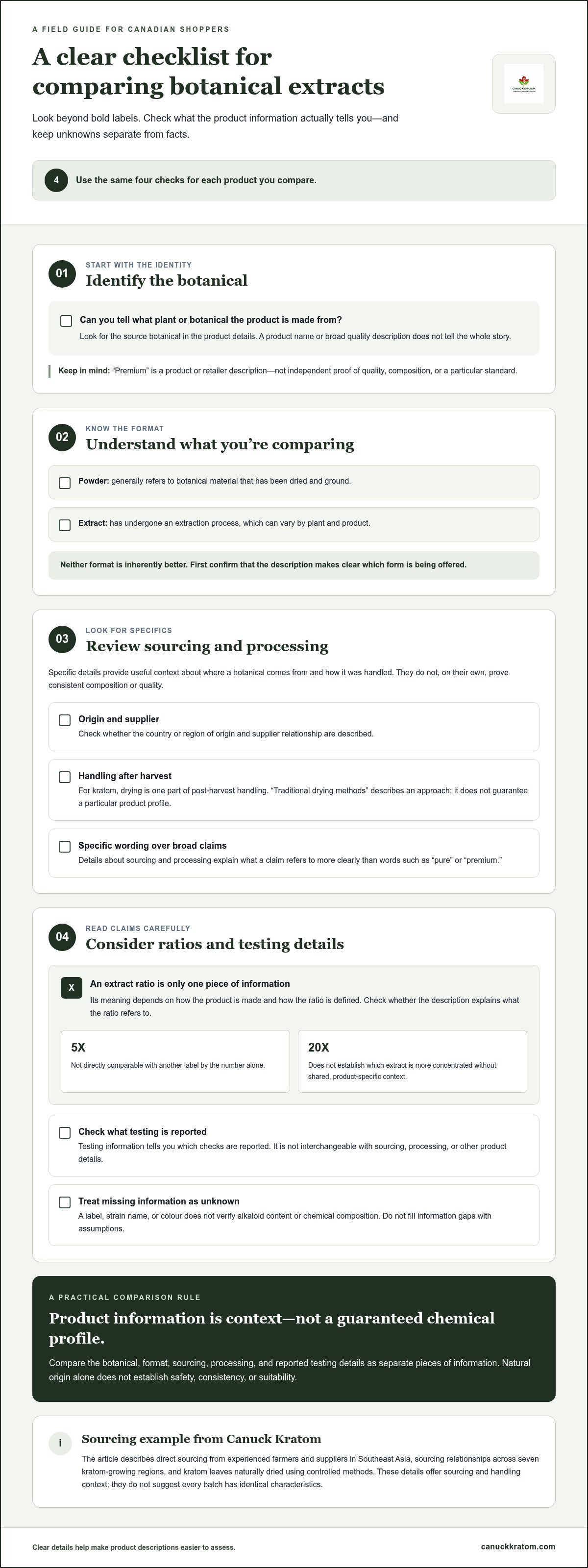
A few focused checks can help you separate useful product details from broad quality claims. Follow this sequence when comparing premium botanical extracts Canada shoppers can order online:
- Identify the botanical. Check the exact plant name and product format. A powder, liquid extract, and other prepared forms aren’t interchangeable descriptions.
- Understand the product profile. Review the listed ingredients and product-specific details. Don’t assume a strain name, colour, or ratio confirms a particular composition.
- Review sourcing and handling. Look for disclosed origin, supplier information, processing, freshness, and storage details. Treat these descriptions as context, not proof that all batches have identical characteristics.
- Assess the testing information. Note whether testing is stated, what its scope is, and whether the information relates to a specific batch. Don’t infer results or documentation from a general testing claim.
In one line: check the botanical, format, ingredients, sourcing, handling, and batch-specific testing details before weighing any quality claim.
Read product information, not just adjectives
Words such as “premium,” “pure,” or “potent” may sound reassuring, but they don’t explain how a botanical was sourced or processed. Compare the concrete information provided instead. If a description leaves a question unanswered, treat that detail as unknown rather than filling in the gap with an assumption.
Natural products aren’t automatically risk-free, and product information alone can’t establish suitability for an individual. Keep a purchase decision separate from health questions. For health or safety concerns, use qualified sources rather than relying on marketing language or a product label.
Order and store responsibly
Canuck Kratom fulfils orders in Canada and ships coast to coast. The online store lets Canadian shoppers review product details and order from across the country. Once a product arrives, follow its storage directions. Don’t assume a shelf life or ideal storage condition that the product information doesn’t state. Canuck Kratom focuses on fresh inventory and proper storage, but product-specific directions remain the guide for each item.
Use these checks as you compare the selection: explore Canuck Kratom’s botanical products and review the information provided for each one before ordering.
Exploring Botanical Extracts from Canuck Kratom
Canuck Kratom’s extract selection includes kratom extract, Kava Kava 5X Extract, Kava Kava 3x 40 percent kavalactone, and Kanna Extract 20X. These names identify different botanical products and label descriptions. They don’t mean every extract is made the same way or has the same composition, testing scope, or product profile. Review each product’s own information rather than comparing names alone.
What Canuck Kratom’s sourcing approach contributes
Canuck Kratom works directly with experienced farmers and trusted suppliers in Southeast Asia, with sourcing relationships across seven kratom-growing regions. The team has more than two decades of experience in the kratom industry and has spent over eight years building relationships with farmers. This background gives shoppers context about the retailer’s sourcing approach, but it doesn’t guarantee identical characteristics across botanicals or batches.
Canuck Kratom’s kratom leaves are naturally dried using controlled methods. This is a processing detail, not proof of a particular chemical profile or a substitute for product-specific information. The company’s botanical products are also laboratory-tested. A general statement doesn’t, by itself, identify the tests or results, or say whether documentation is available for a particular batch. Those details matter when you’re comparing premium botanical extracts Canada-wide.
Keep batch variation in mind when assessing any extract. A product name or ratio can help identify what’s being offered, but it doesn’t establish potency or composition. Check the product description for the botanical, format, ingredients, sourcing, and any testing details provided for that specific item.
Where to continue learning about specific botanicals
If you’re comparing extract and powder formats, the kratom powder sale guide offers a focused look at powder product information. It complements the checks in this guide without suggesting that one format is automatically better.
Apply the same careful approach across the selection: read the details for the specific product, separate clear information from broad claims, and don’t treat “natural” or a concentrated-sounding label as proof of suitability. Browse Canuck Kratom’s botanical products and compare the information in each product description.
Make Your Next Botanical Choice with Confidence
Choosing premium botanical extracts Canada shoppers can order online starts with clear product information, not a bold label. Check the botanical and format, review disclosed sourcing and processing, and look for testing details that explain their scope. An extract ratio or product name can offer context, but it doesn’t guarantee potency or chemical composition.
Canuck Kratom is a Canadian-owned online botanical retailer serving customers across Canada. The company works directly with experienced farmers and suppliers in Southeast Asia and provides domestic fulfilment and coast-to-coast shipping. These details help explain the retailer’s approach, while product-specific information remains essential when comparing extracts.
Take your time, compare what each description actually tells you, and keep broad quality claims in perspective. Explore Canuck Kratom’s botanical products and use the information provided to make a considered choice.
Frequently Asked Questions
What is a botanical extract?
A botanical extract is a prepared product made from plant material through an extraction process. It differs from whole botanical material or powder, which is generally dried and ground rather than extracted. The source plant and processing method shape the finished product, so the word “extract” alone doesn’t tell you its exact composition or concentration. Check the label for the botanical, ingredients, and format.
Are botanical extracts stronger than powders?
Not automatically. A powder is generally dried and ground botanical material, while an extract has been prepared through an extraction process. Relative concentration depends on the product and how it was made. Without clear, comparable product information, you can’t assume an extract is stronger than a powder. Compare the disclosed format and composition rather than treating one form as inherently more potent or higher quality.
What do 5X and 20X mean on an extract label?
Labels such as 5X and 20X are product descriptors, but they don’t have a universal meaning that lets you compare every extract directly. The label alone doesn’t establish a product’s potency or chemical composition. Look for product-specific information explaining what the number refers to. For example, Kava Kava 5X Extract and Kanna Extract 20X are different product names, not proof that their labelled numbers measure the same thing.
How can I assess the quality of a botanical extract?
Start with the botanical’s identity, ingredients, and format. Then review disclosed sourcing, processing, freshness, storage, and testing information. For premium botanical extracts Canada shoppers compare online, specific details are more useful than broad adjectives such as “pure” or “premium.” A strain name, colour, or ratio doesn’t guarantee composition. Consider what the product description actually establishes, and treat missing details as unknown.
What does batch-tested quality control tell me?
Batch-tested quality control means quality checks are supported by testing individual product batches. What that tells you depends on the information provided: a general testing statement doesn’t identify the test scope, results, or whether documentation relates to the batch you’re viewing. Look for clear product-specific information about what was tested and which batch it covers. Don’t assume a test establishes qualities beyond its stated scope.
Are natural botanical extracts automatically risk-free?
No. Natural origin alone doesn’t establish that a botanical product is safe or suitable for every person or purpose. Products can differ in their botanical source, preparation, and composition, and “natural” is not a substitute for clear product information. Don’t rely on a label or marketing claim to answer health or safety questions. For those concerns, consult a qualified health professional or an appropriate official source.
Can I order botanical extracts online in Canada?
Yes. Canuck Kratom is a Canadian-owned online botanical retailer serving customers across Canada, with domestic fulfilment and coast-to-coast shipping. Online availability doesn’t mean every botanical product is authorized for human consumption. Health Canada has not authorized kratom products for human consumption. Read each product’s label and stated purpose carefully, and consult current official Canadian information if you have questions about a product’s regulatory status.