
 Link label

Kava Kava for Stress Relief: What the Evidence Really Says
Does Kava Kava for stress relief have the same evidence behind it as its reputation suggests? Kava has a long history of traditional use, and some clinical research has examined specific extracts for anxiety. That doesn’t establish that every kava product eases everyday stress.
It’s easy to confuse traditional use, anxiety research and broad promises of relaxation. Product labels can also leave important details unclear. Kava is not risk-free: health authorities have raised concerns about rare but serious liver injury, so safety deserves as much attention as potential effects.
This article explains what research suggests, what it can’t establish about everyday stress, and which safety considerations to keep in mind. It also outlines practical details to check when comparing products in Canada, including the extract information, testing details and any Natural Product Number on the label.
Key Takeaways
- Distinguish kava’s traditional use and anxiety research from claims about everyday stress.
- Understand why evidence about Kava Kava for stress relief doesn’t guarantee a particular effect.
- Recognize that “natural” doesn’t mean risk-free, including in light of the liver-related concerns discussed here.
- Compare ingredient identity, plant part, preparation, extract details and batch information where provided.
- Use a step-by-step review of the evidence, safety information and product details before making a decision as a Canadian shopper.
Kava Kava for Stress Relief: What People Mean by the Claim
Could kava help with the pressures of an ordinary day, or does “stress relief” stretch the evidence too far? It depends on what the claim means. Kava Kava for stress relief is often discussed alongside traditional use and research on anxiety, but neither proves that a particular product eases everyday stress for a particular person.
Kava is the common name for Piper methysticum, a plant native to the Pacific Islands. Its roots and underground stems are commonly described in accounts of kava preparation and research. The plant contains compounds called kavalactones, which researchers study for their biological activity. For a foundational overview, see Kava (Piper methysticum) and this clear guide to what kava is.
What is kava, and where does its stress-relief reputation come from?
Kava has longstanding social and ceremonial use in Pacific Island cultures, including as a traditionally prepared drink shared in communal settings. This history helps explain its association with relaxation and social rituals. It does not, on its own, demonstrate a specific health effect.
Products sold today may differ from traditional preparations in their ingredients, plant parts, processing and form. A beverage made from prepared roots isn’t automatically equivalent to a powder or extract. When you see a stress-relief claim, check which preparation it refers to and whether the supporting evidence studied a comparable product.
Is everyday stress the same as anxiety in research?
No. Everyday stress commonly describes a response to pressures such as a demanding schedule or difficult situation. An anxiety disorder is a health condition assessed using clinical criteria. The experiences can overlap, but they aren’t interchangeable research outcomes.
Some studies examine kava in relation to anxiety. Those findings can inform further research, but they don’t automatically show that kava relieves routine stress, improves sleep or has the same effects across products. Personal accounts may describe individual experiences, but they can’t establish what others should expect.
Keep the claim specific: traditional use provides cultural context, while clinical research examines defined outcomes in particular settings. Neither is a guarantee of daily calm. If stress is persistent, intense or affecting your day-to-day life, this article can’t determine its cause or replace support from a qualified health professional.
What Research Says About Kava Kava and Stress-Related Claims
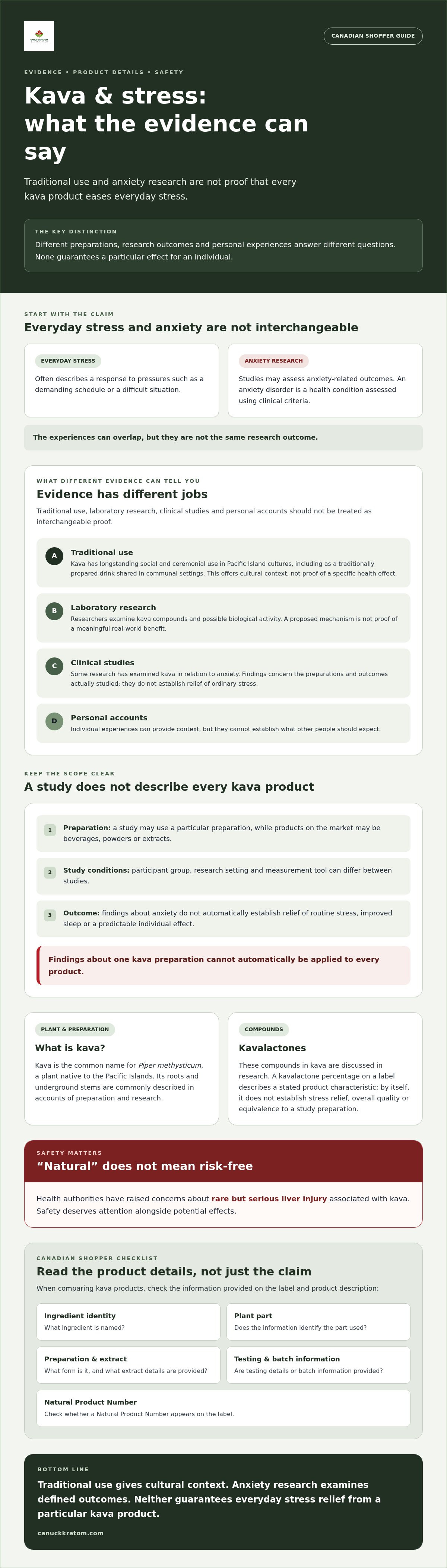
Research can help clarify what a kava claim is based on, but different kinds of evidence answer different questions. Traditional use offers cultural context. Laboratory studies explore compounds and possible biological activity. Clinical studies assess defined outcomes in people, while testimonials describe individual experiences. These shouldn’t be treated as interchangeable proof that Kava Kava for stress relief works for everyday pressures.
What do clinical studies measure, and what do they leave unanswered?
Clinical research on kava has examined anxiety-related outcomes. The National Center for Complementary and Integrative Health’s overview of research on kava for anxiety summarizes this area. Findings may be relevant to questions about anxiety, but they don’t directly establish that kava eases ordinary stress or will have a predictable effect for an individual.
Results depend on what researchers tested and how. A trial may involve a particular preparation, participant group, research setting and measurement tool. Another study may use a different extract or assess a different outcome. These differences make simple comparisons difficult and limit how far a finding can be applied beyond the conditions studied.
Findings about one kava preparation cannot automatically be applied to every product. A study describes the preparation and outcome under investigation, not every kava beverage, powder or extract on the market. Traditional use and personal reports provide context, but neither replaces controlled research. Even a well-designed study can’t promise the same experience for everyone.
Why kavalactones don’t tell the whole story
Kavalactones are compounds in kava that are commonly discussed in research. Laboratory work may examine how they interact with biological systems. This can help researchers form and test possible explanations for an effect, but a proposed mechanism is not proof that a product produces a meaningful real-world benefit.
A kavalactone percentage on a label describes a stated product characteristic. By itself, it doesn’t establish stress relief, overall quality or equivalence to a preparation used in a study. Look beyond the number: check what form was studied, what outcome researchers measured and whether the product information explains how its preparation compares.
For Canadian shoppers comparing listed kava forms, Canuck Kratom’s current kava product information is a place to review the specifications provided. Treat label details as a starting point for comparison, not a promise of an effect.
Kava Kava Safety: Risks and Limits Behind Stress-Relief Claims
“Natural” describes a source, not a safety guarantee. Kava has a history of traditional use, but that doesn’t mean every preparation is risk-free or suitable for every person. Safety matters just as much as any claim about Kava Kava for stress relief.
What safety concerns should readers understand?
Liver-related injury is a serious concern reported in connection with kava products. Memorial Sloan Kettering Cancer Center discusses this issue in its kava safety information. Reports of harm don’t establish the risk for a particular product or person, but they do mean a relaxation claim shouldn’t distract from safety questions.
Some sources also report side effects such as drowsiness, dizziness and headache. Their relevance can depend on the preparation and circumstances of use; a label or product form alone can’t show how an individual will respond. A traditional preparation, an extract and other modern products aren’t automatically equivalent, and no preparation should be assumed to eliminate risk.
When reviewing a product, check whether the information identifies the ingredients and plant parts, explains the preparation or extract, and provides batch details. If details aren’t available, don’t fill the gaps with assumptions. A kavalactone percentage or traditional-use claim cannot, by itself, confirm safety.
Why medication and health context matters
Health history, medications and other substances may be relevant when considering kava. General information can’t account for personal details, and a broad interaction warning isn’t an assessment of your situation. Don’t rely on an online product description to answer individual safety questions.
If you have a health condition, take medication or are unsure whether kava is appropriate for you, speak with a qualified health professional. They can consider your circumstances and advise on relevant risks. This is especially important if you have questions about liver health. The goal isn’t to assume harm or safety, but to make decisions with appropriate personal and product-specific context.
For Canadian shoppers, responsible research means looking beyond a stress-relief headline: review the available product information, note what it doesn’t tell you, and take unresolved safety questions to a qualified professional. No botanical product should be treated as risk-free simply because it comes from a plant.
How to Assess Kava Products Without Assuming Stress Relief
Product information can help you understand what you’re comparing, but it can’t promise how a product will affect you. If you’re researching Kava Kava for stress relief, use the label to assess identity and preparation, not to assume an outcome. Start with what the seller states, then note what remains unclear.
Which label details can help you compare kava products?
Check the listing for these details where provided:
- Ingredient identity: Does it clearly name kava or Piper methysticum?
- Plant part: Does it identify which part of the plant is used?
- Preparation and form: Is it described as a traditional beverage, powder or extract?
- Extract information: Does the listing explain what the extract description or stated percentage refers to?
- Batch and testing details: Is batch information provided? If contamination testing or alkaloid testing is mentioned, check what was tested and whether the information applies to the current batch.
Labels help with comparison, not prediction. Similar names don’t establish that two extracts have the same composition or preparation. A stated percentage describes a product characteristic; it doesn’t prove stress relief, confirm overall quality or show that the product matches one used in a study. If testing details aren’t listed, don’t assume testing was performed. Ask the seller what documentation is available and what it covers.
For more detail on comparing extract descriptions, read this Kava Kava extract buying guide.
How do traditional drinks and extracts differ as product forms?
Traditional kava drinks and modern extracts can differ in preparation, concentration and product information. A drink made from the plant isn’t automatically equivalent to an extract, and the names alone don’t tell you whether their compositions match. For tea-specific product-form information, see the kava tea preparation guide. This comparison is about understanding product forms, not preparation or use instructions.
Canuck Kratom lists kava products in different forms. Explore Canuck Kratom’s kava products and review each listing’s current information, including available specifications and testing details, to see what questions remain.
Kava Kava for Stress Relief: A Guide for Canadian Shoppers
For Canadians weighing kava products, the clearest takeaway is that traditional use and research findings can help frame questions, but they don’t promise a specific stress-relief effect. Anxiety research, in particular, shouldn’t be read as proof that a product will change how you feel during everyday stress. Start with the evidence and product details, not a headline promising calm.
What a careful takeaway should, and should not, promise
Traditional use provides cultural context. Research examines particular kava preparations and defined outcomes. Neither tells you exactly what an individual will experience with a product currently for sale. Treat broad claims with care, especially when they don’t identify the product form or explain what evidence supports them.
Canuck Kratom lists Kava Kava, Kava Kava 5X Extract, and Kava Kava 3x 40 Percent Kavalactone. These are examples of listed products and product descriptions, not proof of an effect or a statement about regulatory status. Check each current listing for the details provided, and don’t assume a product name or percentage confirms a specific outcome.
A simple Canadian shopper checklist before ordering
Before making a decision, use this sequence:
- Clarify your question. Are you looking for information about traditional use, anxiety research or everyday stress? These aren’t interchangeable.
- Review the evidence. Check what preparation and outcome a study examined rather than relying on a general claim about kava.
- Consider safety. Read reliable safety information and seek qualified professional guidance for personal health or medication questions.
- Inspect the listing. Confirm the product identity and format, and check whether current batch information is provided.
- Check transparency. Look for clear sourcing details and whether testing information is available. If the listing doesn’t say, don’t assume testing was done.
- Verify Canadian context. Consult authoritative Canadian sources for current regulatory information. Don’t infer a product’s authorization or Natural Product Number status from its name, format or a general statement about kava.
Clear, current product information helps you compare products, but it can’t remove uncertainty about the evidence or personal experience. The available listings can be reviewed for the details stated, without assuming those details predict an effect.
Make Your Next Kava Decision With Clarity
Kava’s traditional use and research into anxiety offer context, not a guarantee about everyday stress. The evidence behind Kava Kava for stress relief doesn’t establish a specific result for every person or product. Since kava may carry safety concerns, product details deserve as much attention as relaxation claims.
Before deciding, clarify what you want to know, review research that matches your question, consider safety and check the current label for ingredients, preparation, batch details and any testing information. If details are missing, don’t assume they’re covered.
Canuck Kratom is a Canadian-owned online retailer serving customers across Canada. Its listed kava offerings include Kava Kava, Kava Kava 5X Extract and Kava Kava 3x 40 Percent Kavalactone. These are product listings, not promises of an effect. A clear, informed choice starts with good questions: take your time, check the details and consider what remains uncertain.
Review Canuck Kratom’s current kava listings and compare the available product information.
Frequently Asked Questions
Does kava Kava help with stress?
Kava may be associated with relaxation, but research on anxiety doesn’t prove it relieves everyday stress or predict how a particular person will respond. Traditional use, clinical findings and personal accounts are different kinds of evidence. If you’re researching Kava Kava for stress relief, check what outcome a study measured and whether it examined a preparation comparable to the product you’re considering. No general claim can guarantee a specific effect.
Is kava the same as kava Kava?
Yes. “Kava” and “kava kava” are commonly used names for the same plant, Piper methysticum. The wording alone doesn’t tell you what’s in a particular product. Product forms and preparations can vary, so check the ingredient description, plant part and extract details on the label or listing. Similar names don’t guarantee that two products have the same composition or match a preparation studied in research.
Can kava Kava interact with medications?
Kava may interact with medications, and individual circumstances matter. The possible relevance can depend on the product, other substances or medicines a person uses, and their health history. General online information can’t determine whether a specific combination is appropriate for you. If you take medication or have questions about using kava alongside it, speak with a qualified health professional who can consider your circumstances rather than relying on a product description alone.
What are the possible risks of using kava Kava?
Reported concerns include rare but serious liver injury, as well as side effects such as drowsiness, dizziness and headache. The risk for an individual or a specific product can’t be established from a label alone, and no natural preparation should be assumed risk-free. Product form, preparation and personal health context may matter. If you have concerns about liver health or other risks, seek guidance from a qualified health professional.
How does kava tea differ from kava extract?
Kava tea is a beverage traditionally prepared from the plant, while an extract is a product made by processing kava into a concentrated form. The ingredients, preparation and product details can differ, so the two forms shouldn’t be assumed equivalent. Research on one preparation doesn’t automatically apply to another. Check the listing for the exact form and extract description, and avoid treating the name alone as a measure of composition or expected effects.
What should I look for on a kava product label in Canada?
Check the ingredient identity, plant part, product form, preparation or extract description, and any available batch information. Look for clear sourcing and testing details, but don’t assume testing was done if the label or listing doesn’t say so. A kavalactone percentage describes a stated product characteristic, not a guaranteed outcome. If a Natural Product Number appears, verify what product and claims it applies to through authoritative Canadian information.
Is kava Kava approved as a treatment in Canada?
Kava isn’t a blanket-approved treatment in Canada. Any authorization or permitted health claim is specific to an individual product, so don’t assume that every kava product has been reviewed or authorized for the same use. Check the product label and verify its status and claims using current Health Canada information. A product name, extract description or general statement about kava doesn’t establish regulatory approval or mean it’s appropriate for you.