
 Link label

Sceletium Tortuosum Extract in Canada: 2026 Guide
What if “20X” sounds precise but still doesn’t tell you what’s in the extract? If you’re researching Sceletium tortuosum extract Canada, you’ve likely seen kanna, plant extract and strength-style labels used side by side. Before comparing products, it helps to separate what a label states from what it doesn’t explain.
Sceletium tortuosum is the botanical name commonly associated with kanna. An extract label, however, doesn’t automatically explain how the plant was processed, which compounds are present or how one batch compares with another. A label such as Kanna Extract 20X is a product description, not by itself a verified measure of alkaloid content or a guarantee of composition.
This guide explains the plant and common product terms, how to read labels carefully and what testing details can tell you. It also covers relevant Canadian product information, including why health-related marketing language isn’t a substitute for clear details. The goal is to help you assess what a label says, what it leaves unanswered and how to shop with care, without relying on health promises.
Key Takeaways
- Understand how kanna, Sceletium tortuosum and botanical extracts relate, without assuming every extract has the same formulation.
- Use details such as botanical identity, ingredients and batch information to assess what a product description actually tells you.
- When researching Sceletium tortuosum extract Canada, separate general plant research from information verified for a specific product.
- Learn what a Natural Product Number indicates in Canada and why it doesn’t apply to every botanical listing.
- Understand why a “20X” label, including Canuck Kratom’s Kanna Extract 20X listing, isn’t by itself proof of alkaloid content or composition.
What Is Sceletium Tortuosum Extract? Understanding Kanna in Plain Language
Sceletium tortuosum is the botanical name commonly associated with kanna, a plant originating in South Africa. A scientific name can identify a plant more specifically than a broad label such as “herbal extract.” For an overview of the plant and its alternate botanical name, see the Mesembryanthemum tortuosum Wikipedia page.
Sceletium tortuosum extract is a botanical product made by processing material from the kanna plant, with its precise preparation and composition depending on the product. The plant’s identity, the method used to prepare an extract and the contents of the finished product are separate details. One doesn’t automatically confirm the others.
Is Sceletium tortuosum the same thing as kanna?
Kanna is a common name associated with Sceletium tortuosum. Seeing the botanical name can help identify which plant a product refers to, while “kanna” may be used more broadly in product descriptions. Neither name tells you that different products contain identical plant material or were prepared in the same way. Treat the name as a starting point, not a complete product profile.
What does the word extract mean on a botanical product?
An extract is a botanical product prepared by processing plant material. The word alone doesn’t identify the processing method, the amount of starting material or the finished product’s chemical profile. When comparing labels, look for a description of the extract, any stated processing information and composition details. Don’t treat “extract” as a standardized formulation.
For Canadian shoppers researching Sceletium tortuosum extract Canada, this distinction offers a practical starting point. A label may name the plant and call the product an extract while leaving other questions unanswered. A number or strength-style term also doesn’t, by itself, establish a measured concentration or composition. Supporting details are more informative than a name alone.
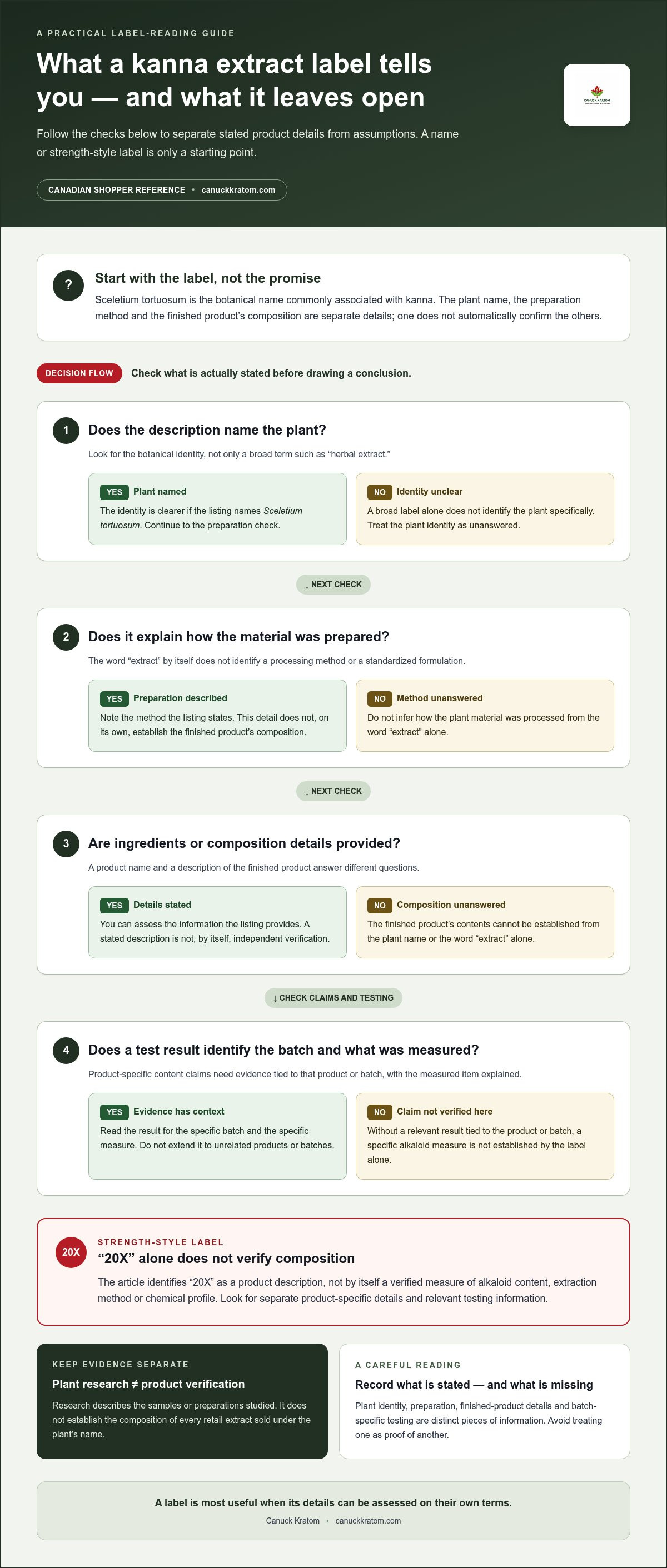
Keep these details separate when assessing a listing:
- Plant identity: Does the description name Sceletium tortuosum?
- Preparation: Does it explain how the botanical material was processed?
- Finished product: Does it describe the ingredients or composition?
These questions help you compare the information provided without assuming that every product labelled kanna or extract is the same.
How Sceletium Extracts Are Described: Plant Compounds, Processing, and Research
Research on Sceletium tortuosum can describe compounds found in the plant, but it can’t establish the composition of every retail extract. Findings about plant material or a particular preparation don’t automatically apply to a finished product made from a different source or process.
What should readers know about Sceletium alkaloids?
Scientific literature describes alkaloids in Sceletium, including mesembrine-type compounds. Alkaloids are naturally occurring chemical substances found in plants. A review by Gericke and Viljoen discusses the plant’s chemistry and research. Check the full paper for compound-level details before using them to interpret a product label. Read the review in the Journal of Ethnopharmacology.
Keep three evidence levels distinct. Laboratory research may identify or measure compounds in a sample under specific conditions. Human research examines a particular preparation in people, and its findings relate to the preparation and study design involved. Neither type of evidence establishes what’s in an unrelated retail product. A product-specific statement about alkaloid content needs evidence tied to that product or batch, such as a relevant test result that explains what was measured.
Why can extract descriptions and product profiles vary?
The starting plant material and the way it’s processed can shape a botanical product’s profile. Products may also vary between batches. Without product-specific information, general descriptions of Sceletium chemistry can’t tell you how much of a particular compound is present in a finished extract.
Research about a plant describes what scientists found in their samples. It doesn’t verify the composition of every extract sold under that plant’s name. Keep this distinction in mind when weighing research summaries against product claims.
For example, Canuck Kratom lists Kanna Extract 20X. That label identifies a product, but “20X” alone doesn’t verify a standardized alkaloid measure, extraction method or chemical profile. Separate confirmed details from unanswered questions:
- Research: What material or preparation did the study examine?
- Product information: Does the description explain sourcing or processing?
- Testing: Are results tied to a specific batch, and do they state what was measured?
Canadian shoppers comparing Sceletium tortuosum extract Canada listings can use these questions to interpret claims without treating research as a product guarantee. For more context about the listing, see the Kanna Extract 20X product information.
How to Assess Sceletium Tortuosum Extract Labels Without Assuming Too Much
A useful product label gives you details you can assess, not just a name or strength-style claim. If you’re comparing Sceletium tortuosum extract Canada listings, use this checklist to distinguish the information provided from assumptions.
What details make an extract label more informative?
Look for the botanical name, a clear extract description, a full ingredient list, the product form and batch identification. These details help you understand how the product is described and whether any testing information can be linked to a particular batch.
- Botanical identity: Does the label identify Sceletium tortuosum, rather than relying only on a common name?
- Extract and ingredients: Does it describe the extract and list other ingredients?
- Batch details: Is there a batch or lot identifier that links the product to records or test results?
- Testing information: Does it name what was tested and provide results or a clear summary?
A stated extraction ratio can provide context, but it doesn’t give a complete account of composition. Look for an explanation of what the ratio compares and how it relates to the finished product. Without that context, the figure doesn’t establish the amount of any particular compound.
The same caution applies to “20X.” It’s a label term, not proof of a standardized alkaloid concentration or a specific chemical profile. If a product description doesn’t define the term with supporting product-specific evidence, treat its meaning as unknown rather than filling in the gap yourself.
What can contamination testing and alkaloid testing tell you?
Contamination testing checks for specified unwanted substances. Alkaloid testing analyses identified alkaloids, where that testing is available. Both terms are more useful when the information identifies the sample or batch, the substances tested and the results. A general statement that a product is “tested” doesn’t tell you those details.
Batch-tested quality control is meaningful when its scope is described. A result relates to the sample and substances included in that test. It doesn’t answer every quality question, verify untested compounds or automatically apply to other batches.
As you assess a listing, separate what’s stated from what isn’t. A missing method, ingredient detail, batch identifier or test result is unknown. Reading carefully gives you a clearer basis for comparing product information without treating a label as a guarantee.
What Canadian Shoppers Should Know About Sceletium Product Information
Plant research and Canadian product records answer different questions. A study may describe a plant or a particular extract, but it doesn’t establish the regulatory status, licence or permitted claims of every product sold under a similar name. When reviewing Sceletium tortuosum extract Canada listings, keep research claims separate from product-specific information you can verify.
Does every Sceletium product have a Natural Product Number?
A Natural Product Number is an eight-digit number carried by licensed natural health products in Canada. It identifies a product record, not every botanical item. Don’t assume every product described as kanna or Sceletium must carry one, or that a number on a label proves the product is identical to another listing.
If a product shows a Natural Product Number, look it up in Health Canada’s Licensed Natural Health Products Database. Compare the official record with the product, including its name and other identifying details. A similar name alone doesn’t establish a match. If you can’t find a corresponding record, treat the product’s status as unverified rather than guessing.
How can you check Canadian product information responsibly?
Start with the product label, then consult current official Canadian sources for product-specific records. Don’t draw conclusions about approval, legal status or permitted use from a general research paper or a botanical name. Each source has a different role:
| Information source | What it can tell you | What it can’t establish by itself |
|---|---|---|
| Product label | Stated identity, ingredients and label details | Whether every statement is independently verified |
| Testing information | What a sample or batch was tested for, if the scope and results are supplied | Every aspect of quality or the status of other batches |
| Official product record | Whether a matching product record appears in the database | That a similar name refers to the same product |
Use exact identifiers where available, and compare the record with the product details rather than relying on a broad ingredient match. If details don’t line up, leave the question open. That’s more reliable than treating general botanical research as proof about a specific retail item.
To review a labelled example, explore Kanna Extract 20X product information and consider the label alongside these distinctions.
Exploring Kanna Extract in Canada: A Careful Next Step
For a more informed comparison, keep four details separate: plant identity, extract processing, label claims and product-specific test information. The botanical name tells you which plant a product refers to. Processing details describe how its material was prepared. A label gives the seller’s stated information, while relevant test results can provide evidence about a particular sample or batch. Don’t assume any of these details from a product name alone.
How does Kanna Extract 20X fit into this guide?
Canuck Kratom lists Kanna Extract 20X among its botanical products. The “20X” wording is part of the product label, but it doesn’t by itself establish a standardized alkaloid concentration, extraction method or chemical composition. Review the product information to see what it states, and leave details it doesn’t provide unanswered rather than filling in the gaps.
If you’re comparing kanna listings, the Kanna extract buyer’s guide offers related selection context. Read product descriptions closely and distinguish label language from information supported by a specific test or record. This is a practical way to assess Sceletium tortuosum extract Canada listings without treating a name as a guarantee.
Where can you learn more about botanical extract quality?
Keep the same questions in view when comparing botanical extracts: Is the plant identity clear? Are processing details supplied? Can batch information connect the product to relevant records? Does testing information explain its scope and results? A stated test is most useful when you can tell what was tested and which sample the result describes.
The Canadian botanical extract quality guide covers these considerations in more detail. Use it alongside the product description, not as a substitute for product-specific evidence. A careful review helps you distinguish what’s documented from what remains unknown.
Ready to browse with those questions in mind? Explore Canuck Kratom online and take a clear, responsible approach to evaluating product information.
Make Your Next Kanna Purchase an Informed One
Understanding Sceletium tortuosum extract Canada starts with separating the plant name from how an extract is prepared and what’s verified for the finished product. Labels can offer useful clues, but terms such as “20X” don’t establish a standardized alkaloid concentration. Testing is most informative when you can see what was tested, which batch the results relate to and what they show.
For Canadian product context, check official records when a product displays a Natural Product Number, and match the record to the product rather than relying on a similar name. Treat details that aren’t supplied as unknown. This approach helps you weigh product information without turning general research or marketing language into a promise.
Canuck Kratom is a Canadian-owned online botanical retailer serving customers across Canada, and its listed products include Kanna Extract 20X. Explore the listing with the same careful attention you’ve brought to the label details in this guide.
Explore Canuck Kratom online and continue your research with confidence and care.
Frequently Asked Questions
What is Sceletium tortuosum extract?
Sceletium tortuosum, commonly called kanna, is a plant native to South Africa. An extract is a botanical product prepared by processing plant material, but methods and finished composition can differ between products. The word “extract” alone doesn’t reveal those details. Check each label for its ingredients, preparation information and any supporting test results rather than assuming general information about the plant describes a specific product.
Is Sceletium tortuosum the same as kanna?
Kanna is a common name associated with Sceletium tortuosum. The botanical name can help identify the plant a product refers to, while the common name may appear more broadly in descriptions. Neither name proves that two products have the same ingredients, preparation or composition. When comparing listings, look for the botanical name and product-specific details, such as the ingredient list and extract description.
What does 20X mean on a kanna extract label?
“20X” is a label term, not proof of a standardized alkaloid measurement. A stated extraction ratio, if provided, isn’t the same as verified chemical analysis. Check whether the product description explains the term and whether any test information identifies the batch, substances measured and results. Without supporting detail, don’t infer a particular composition or potency from the label.
How can I assess the quality of Sceletium tortuosum extract?
Review the botanical identity, ingredient list, processing details, batch identification and scope of any testing. A test report is more informative if it identifies the sample or batch and explains what was measured. These details support a clearer comparison, but they don’t answer every quality question. A natural origin or bold label claim alone doesn’t verify safety, purity or composition.
Is Sceletium tortuosum extract legal in Canada?
Don’t assume a product’s status from its botanical name alone. Product-specific regulatory information may depend on the product and how it is represented, so consult current official Canadian sources for relevant records. A research paper about Sceletium tortuosum describes research, not the regulatory status of every retail product. General claims or similar product names aren’t proof of a specific item’s status.
Does Sceletium tortuosum extract have a Natural Product Number?
A Natural Product Number is an eight-digit number carried by licensed natural health products in Canada. Don’t assume every botanical product has one. If a listing or label provides a number, look it up in official Canadian product records and compare the record with the exact product name and details. A matching record supports only what that record states; it doesn’t verify claims beyond its scope.
What is the difference between kanna and Kanna Extract 20X?
Kanna is a common name associated with Sceletium tortuosum; Kanna Extract 20X is a specific product label listed by Canuck Kratom. The label alone doesn’t establish the extraction method or alkaloid concentration. Review the stated ingredients and any available batch-specific testing details to assess the product information. Don’t infer chemical properties from the name or assume all products called kanna are prepared alike.