
 Link label

Amanita Muscaria Grade A Caps: A Canadian Buyer’s Checklist
What does “Grade A” tell you about Amanita Muscaria grade A caps? The label may describe how a seller sorts caps by appearance, but it doesn’t establish their composition, potency, or safety. Grading criteria can differ between sellers, so a polished photo or product name can’t answer every important question.
Before choosing a product, compare the stated species, form, cap condition, and available product information. Check how the seller explains sourcing and handling, and distinguish product-specific evidence from broad claims. This checklist shows what a grade label can and can’t tell you, so you can make an informed decision without drawing conclusions from appearance or assumed effects. It also puts Canuck Kratom’s Amanita Muscaria Red Grade A Caps in context for Canadian shoppers.
Key Takeaways
- Understand what “Grade A” may describe and why Amanita Muscaria grade A caps should be assessed on more than appearance.
- Use a focused product-information checklist to review species, form, cap condition, and listing language.
- Compare cap listings using consistent criteria, while noting details that remain unclear.
- Review available evidence and current official Canadian information as part of a responsible purchasing process.
- Explore Canuck Kratom’s Amanita Muscaria Red Grade A Caps with a clear understanding of what the product name does and doesn’t establish.
What Does Grade A Mean for Amanita Muscaria Caps?
For Amanita muscaria caps, “Grade A” is best understood as a seller’s product classification. One listing may use it for whole, visually appealing caps; another seller may use different criteria. The label alone doesn’t establish a cap’s identity, origin, chemical composition, potency, or safety.
Quotable definition: “A Grade A label describes a seller’s chosen visual category; verified product characteristics require separate, clear supporting information.” Keep that distinction in mind when comparing Amanita Muscaria grade A caps. Appearance can help you assess presentation, but it can’t answer every question about the product.
Is Grade A a standardized Amanita Muscaria classification?
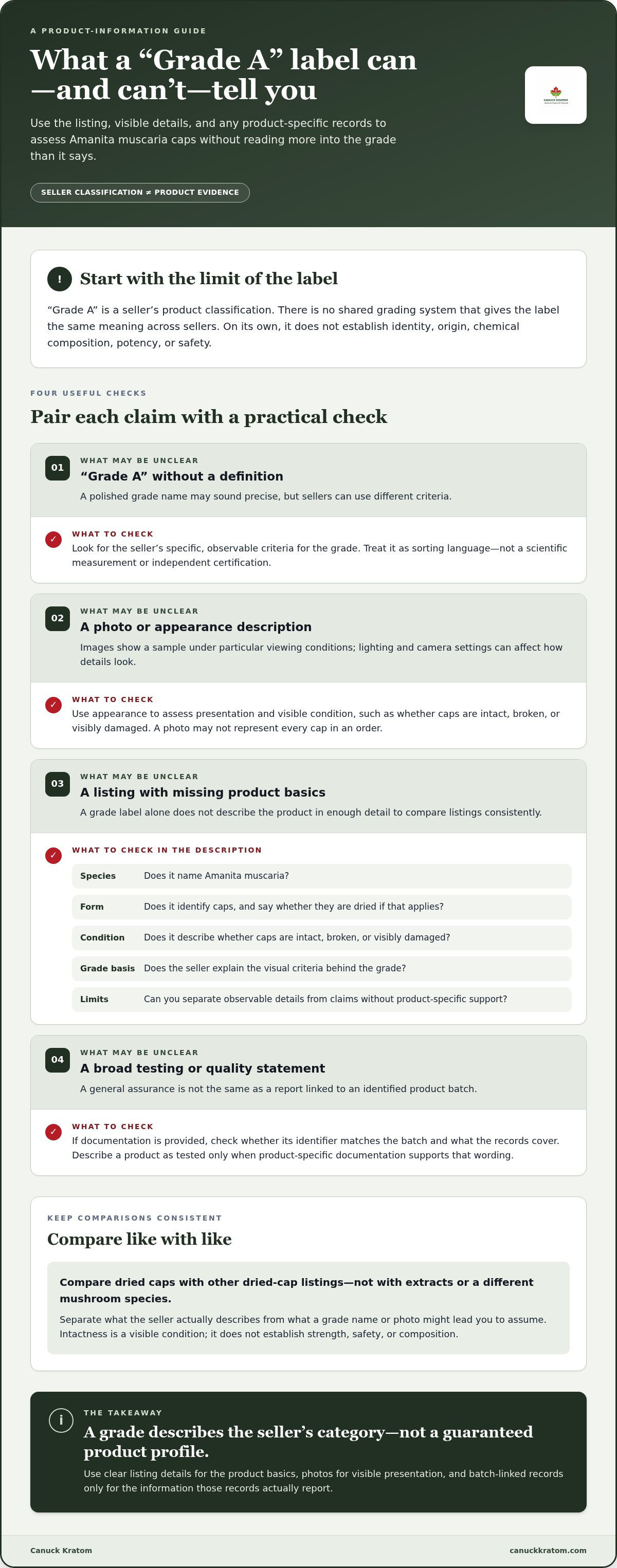
There’s no shared, universally recognized grading system that gives “Grade A” the same meaning across sellers. Treat it as commercial sorting language, not a scientific measurement or independent certification. Check whether the listing defines the grade in observable terms or simply uses it as a quality-sounding description.
Even a detailed grading description explains only how that seller sorts or describes the caps. It doesn’t independently verify where they came from, whether they were tested, or what they contain. Look for product-specific information separately, and distinguish documented details from promotional wording.
What can a cap’s appearance tell you?
Appearance can help you assess visible presentation. A listing may describe caps as intact, whole, or visibly damaged. These are observations about condition, not evidence of potency or effects. Colour and surface details can also appear different depending on lighting, camera settings, and how the product is displayed.
Photos have limits: they show a pictured sample under particular viewing conditions and may not represent every cap in an order. A photograph of carefully arranged, unbroken caps doesn’t establish that every item will look identical. Read the description alongside the images, and note whether it explains the condition being represented.
Visual inspection alone can’t confirm species identity or chemical composition. For background on the mushroom, the Amanita muscaria overview covers its taxonomy and other foundational information. That general reference doesn’t verify a particular product. Photos and grade labels describe presentation; claims about identity, composition, or testing need relevant product-level evidence.
Amanita Muscaria Grade A Caps: Product-Information Checklist
A clear listing helps you separate concrete product details from a seller’s descriptions. Use the checklist below to assess what’s stated, what’s supported, and what remains unspecified. A grade label is one piece of information, not a substitute for details about the product.
Which product details should a listing make clear?
Start with the basics. The listing should identify Amanita muscaria by name and describe the product form as caps. If they are dried, that should be stated plainly. Look for a straightforward description of visible condition and an explanation of what the seller means by “Grade A.” Specific wording gives you a basis for comparison instead of leaving you to interpret the label on its own.
- Species: Does the listing name Amanita muscaria?
- Form: Does it say caps, and does it describe them as dried if that applies?
- Condition: Does the description say whether caps are intact, broken, or visibly damaged?
- Grade basis: Does the seller explain the visual criteria behind the grade?
- Limits: Can you distinguish observable details from claims without product-specific support?
Quotable guideline: “A clear dried-cap description should identify the species and form, describe the caps’ condition, explain the seller’s grading criteria, and separate documented batch details from general claims.”
Read descriptive words carefully. Terms such as “premium,” “pure,” or “exceptional” are seller wording unless the listing explains what they mean and provides relevant support. Don’t infer origin, harvest practices, cap size, or processing methods unless those details are actually stated.
How should you assess testing and batch information?
Batch information can connect a product to records for a particular lot. If documentation is provided, check whether its identifier matches the batch described and what the records cover. A testing document is useful only within its stated scope. Don’t treat it as proof of characteristics it doesn’t measure or report.
Keep general quality statements separate from results for an identified batch. Describe Amanita Muscaria grade A caps as tested only when product-specific documentation supports that wording. A broad seller assurance and a batch-linked report aren’t interchangeable. If testing details aren’t included, don’t assume testing took place or that a grade label fills the information gap.
For an example of a product name, you can review Amanita Muscaria Red Grade A Caps alongside these criteria. Read the product description for the details it states, and treat the grade as a seller’s classification, not proof of composition or effects.
Compare Grade A Caps With Other Listings Without Overreading the Label
Side-by-side comparisons are most useful when you hold the product type constant. Compare dried caps with other dried-cap listings, not with extracts or a different mushroom species. Separate what the seller actually describes from what a grade name or photo might lead you to assume.
Keep this distinction in view: “Grading describes a seller’s sorting criteria, not a guaranteed chemical profile.” Intactness is a visible difference in condition. It doesn’t establish that the material is stronger, safer, or different in composition.
How do Grade A, broken, and unopened descriptions differ?
“Grade A,” “broken,” and “unopened” are listing descriptors. Their meaning depends on how each seller defines them. A seller might use “broken” for visible pieces, while “unopened” may refer to a cap’s appearance. Unless the listing explains its criteria, don’t assume that two sellers use the terms in the same way. None of these labels ranks caps by effects, strength, or suitability.
Which comparison questions reveal useful differences?
Use the table to organize what each listing says. Fill it from the product description, not from guesses based on a title or image. “Not stated” is a useful finding: it marks a gap without assuming why the detail is absent.
| Listing wording | Described condition | Available batch details | Questions to resolve |
|---|---|---|---|
| “Grade A” | Does the description define the grade in observable terms? | Are any records tied to a specific batch? | What criteria does the seller use for this label? |
| “Broken” | Does the listing explain what condition or degree of breakage it means? | Are batch details provided, or not stated? | Is the product still described as caps, and what does the condition description cover? |
| “Unopened” | Does the seller explain what “unopened” describes? | Are records linked to the listed batch? | Is the term defined clearly, or left unexplained? |
Compare how specific each description is. One listing may explain its sorting terms and cap condition, while another may rely mainly on a grade name. That difference tells you about the information presented, not necessarily about the products’ chemistry. Photos can help you judge visible presentation, but they don’t document batch characteristics.
When comparing Amanita Muscaria grade A caps, record product facts separately from seller wording. A stated species and cap form are listing details; “premium” is an opinion unless defined and supported. Don’t infer testing, origin, processing, or composition from intact caps or a polished image. This keeps the comparison grounded in what the listing actually says.
Responsible Amanita Muscaria Purchasing: A Practical Checklist
A careful purchase starts with evidence, not a persuasive grade name. Use this process to assess a listing, keep confirmed details separate from assumptions, and consult current Canadian information. Natural origin doesn’t make a botanical product risk-free, and appearance alone can’t settle questions about identity or composition.
- Read the complete listing. Check the named species and product form, then read the full description of condition and grading criteria. Don’t rely on a product title, a single photograph, or the phrase “Grade A” to fill in details the listing doesn’t state.
- Assess the supporting information. Separate specific product facts from broad promotional language. If a listing mentions testing or batch records, look for details that connect them to the product or batch in question. Don’t treat a general quality statement as proof of testing, composition, or safety.
- Compare like with like. Compare caps with caps, using the same questions for each listing: what form is described, what condition is stated, and what evidence is provided? Mark unanswered questions as unknown instead of filling gaps with assumptions based on photos or seller wording.
- Review current official Canadian information. Requirements and guidance can change. Consult relevant, up-to-date Canadian government sources for information that applies to the product and its intended use. Don’t infer Canadian requirements from another country’s retailer, product page, or search result.
What should you review before choosing a listing?
Make a quick record of what the listing establishes and what it leaves open. For example, a description may identify Amanita muscaria caps and state their visible condition, while saying nothing about batch documentation. These are separate points: the stated form and condition are listing details; the absence of batch information remains unknown. This distinction helps you assess Amanita Muscaria grade A caps without treating a label as evidence for more than it says.
How can Canadian shoppers approach regulations responsibly?
Use official Canadian sources for current information, and check the context of the guidance rather than relying on search snippets or old discussions. This checklist offers general purchasing information and doesn’t determine whether a particular product or use meets applicable requirements.
To apply the checklist to a product listing, explore Canuck Kratom’s Amanita Muscaria caps and review the available product information carefully.
Canuck Kratom’s Amanita Muscaria Red Grade A Caps
Canuck Kratom is a Canadian-owned online botanical retailer serving customers across Canada. Its Amanita product is named Amanita Muscaria Red Grade A Caps. The product listing gives Canadian shoppers a specific offering to assess using the criteria in this guide: species name, cap form, description, and supporting information.
Read “Red Grade A” as the product’s stated label, not as a universal grading standard. Those words alone don’t establish chemical composition, potency, effects, or safety. A responsible comparison focuses on the product information provided and avoids filling gaps with assumptions based on a grade name.
How does the product fit the checklist?
The product name identifies Amanita Muscaria and caps, while “Red Grade A” is part of the seller’s label. Keep those points distinct as you review the product description. Consider what it states directly, and don’t treat the label as proof of origin, testing, or handling practices. This keeps your assessment factual without assigning the grade a meaning beyond the information provided.
For Amanita Muscaria grade A caps, specific claims about a batch or its characteristics should be supported by product-specific information. Don’t assume a detail is established simply because it might be common in product descriptions elsewhere. A careful read helps you identify what’s stated and what the label itself cannot tell you.
What is a sensible next step for Canadian shoppers?
Review the product description, compare its stated details with the checklist, and decide whether the information is clear enough for your needs. Canuck Kratom offers botanical products through an online platform for customers across Canada. An informed choice doesn’t require treating “Grade A” as a guarantee.
For broader context on evaluating botanical product information, read Premium Botanical Extracts in Canada: A Clear Guide to Quality. Then consider the product details in light of the criteria above, rather than making assumptions about what the grade means.
Choose Amanita Caps With Clearer Information
A “Grade A” label is a seller’s classification, not a universal measure of composition, potency, or safety. When comparing Amanita Muscaria grade A caps, review the stated species, product form, visible condition, and any product-specific batch information instead of relying on a grade name or photograph alone.
Keep confirmed listing details separate from promotional wording, and treat missing information as unknown. Natural origin doesn’t mean a botanical product is risk-free, so take a careful approach and review current official Canadian information relevant to your decision.
Canuck Kratom is a Canadian-owned online retailer serving customers nationwide, with Amanita Muscaria Red Grade A Caps among its product offerings. Review the product information at your own pace and decide whether it meets your needs.
Explore Canuck Kratom’s botanical products online and make your next choice with care.
Frequently Asked Questions
Are Grade A Amanita Muscaria caps more potent than other grades?
No. A Grade A label alone can’t show that caps are more potent than caps assigned another grade. Seller-defined or appearance-based sorting describes a category, not a verified chemical profile, and it doesn’t support predictions about effects. Review clear product information and any batch-specific documentation provided, noting what it actually covers. Without relevant evidence, don’t interpret a grade name or visual condition as proof of potency.
How can you tell whether Amanita Muscaria caps are good quality?
Assess the listing’s clarity and supporting details rather than relying on a single visual cue. Check that it names Amanita muscaria, identifies caps as the product form, describes their condition, and explains its grading criteria. Review any relevant batch information as well. Photos may show visible presentation, but lighting and sample selection limit what they establish. Appearance alone can’t verify identity, composition, or safety.
Does an intact cap mean Amanita Muscaria is safer or stronger?
No. An intact cap doesn’t establish that Amanita muscaria is safer or stronger than a broken one. “Intact,” “broken,” and “unopened” may refer to visible condition or a seller’s sorting category, and sellers may define these terms differently. Keep those descriptions separate from verified chemical information. Neither a cap’s appearance nor its grade independently confirms composition or safety, so avoid drawing conclusions beyond relevant product documentation.
Is Amanita Muscaria legal to buy in Canada?
There isn’t a responsible blanket answer here: whether a purchase is permitted can depend on current requirements and the product’s circumstances. Rules and regulatory guidance may change, so review current official Canadian sources relevant to your situation before deciding. Check that the information is current and applies to your circumstances. Don’t rely on an overseas retailer’s statement or a search snippet as proof of Canadian requirements. This general information isn’t legal advice.
Does a Grade A label mean Amanita Muscaria caps have been lab tested?
No. “Grade A” describes a seller’s grade or sorting category; it doesn’t confirm laboratory testing. Look for product-specific details that identify what was tested, which batch the information applies to, and what the results cover. A broad statement about quality isn’t the same as documented results for a particular batch. If no batch-linked testing information is provided, don’t infer that testing occurred from the grade label.