
 Link label

Dried Amanita Muscaria in Canada: A Clear Guide to Identification and Quality
What can a vivid cap photo really tell you? If you’re researching dried Amanita Muscaria Canada, appearance alone can’t explain how a product was sourced, handled or tested. Dried caps, extracts and other preparations are different product forms, and broad quality claims don’t replace clear, specific information.
It’s reasonable to want straightforward answers before considering a purchase. In Canada, Amanita muscaria isn’t listed as a controlled substance, but that doesn’t mean a product is approved for human consumption. Products sold as natural health products require Health Canada licensing and a Natural Product Number (NPN). An ingredient-database listing alone isn’t product approval.
This guide explains what dried caps are, how they differ from extracts, and which product details can help you assess sourcing, processing, testing and storage. It also covers the Canadian regulatory context and why a photo or label can’t promise safety or effects. Canuck Kratom lists Amanita Muscaria Red Grade A Caps, which you can review while learning what product information to look for and making an informed decision.
Key Takeaways
- Understand what “dried” means and why dried caps aren’t the same product form as extracts.
- Learn why colour, spots and product photos alone can’t confirm a mushroom’s identity or quality.
- Use practical details such as batch identification, processing information and storage guidance to assess product claims.
- For dried Amanita Muscaria Canada, review what testing covers and check current Canadian rules through official sources.
- Remember that natural or dried doesn’t mean risk-free, and no checklist can guarantee identity or safety.
What is dried Amanita muscaria, and what does the dried form mean?
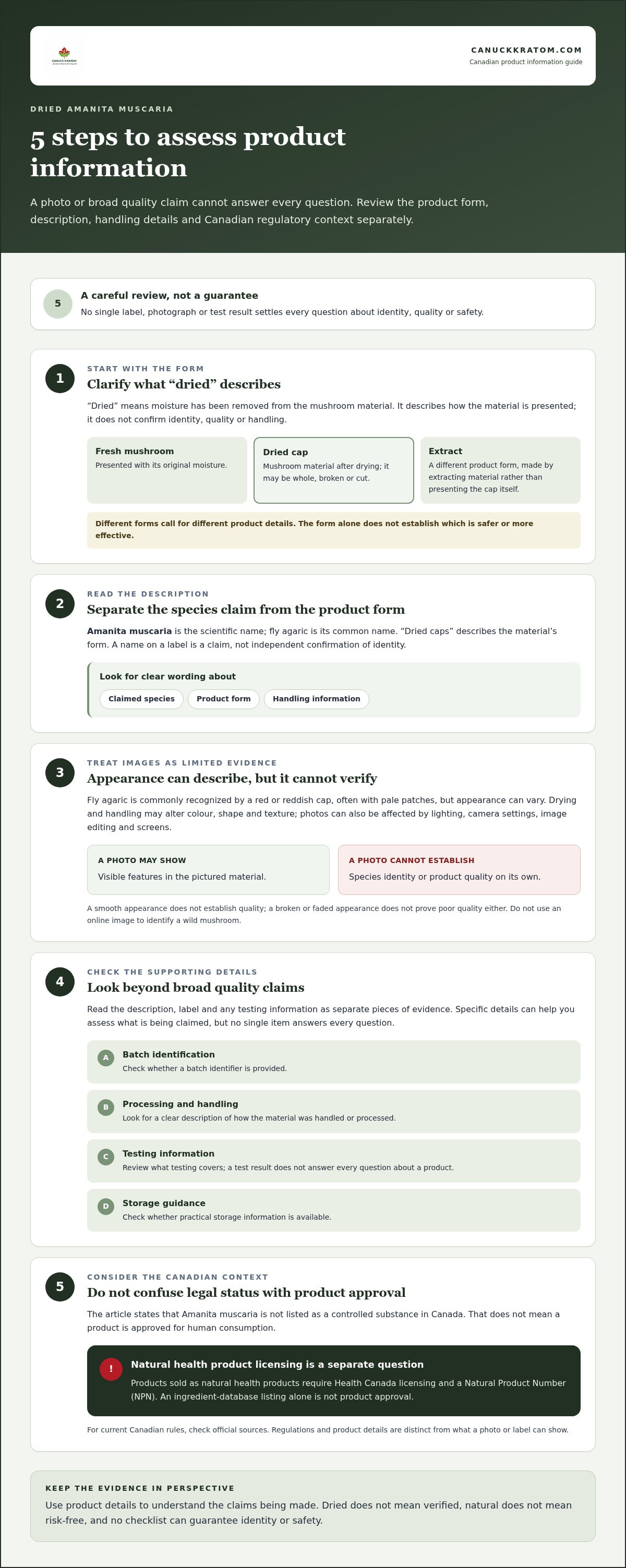
Amanita muscaria is a mushroom species commonly known as fly agaric. In a product description, “dried” means moisture has been removed from the mushroom material. It describes the product’s form, not proof of its identity or how it was handled. For anyone researching dried Amanita Muscaria Canada, that distinction is a useful starting point.
Amanita muscaria is the species; dried Amanita muscaria is fungal material presented after drying. Dried caps remain mushroom material. The word “dried” doesn’t confirm species identity, product quality or safety, and it doesn’t tell you exactly how the product was processed.
How do dried caps differ from fresh mushrooms and extracts?
Fresh mushrooms are presented with their original moisture, while dried caps may appear whole, broken or cut. An extract is a different product form, made by extracting material rather than presenting the cap itself. These differences describe what’s being offered, but they don’t establish which form is safer or more effective.
Different forms call for different product details. For caps, look for clear information about the material and its handling. For an extract, the description should identify it as an extract and explain what product information is available. Drying alone doesn’t standardize material or establish what it contains.
What does the name Amanita muscaria refer to?
Amanita muscaria is the scientific name; fly agaric is its common name. The species is often recognized by its red cap and pale spots, but appearance can vary, and a label or photograph can’t verify a dried item. For broader context on the mushroom’s characteristics and distribution, see Amanita muscaria general information.
Names are useful, but they’re only one part of a product description. “Fly agaric” or Amanita muscaria on packaging isn’t independent confirmation of identity. The same careful approach applies across botanical formats: premium botanical extracts in Canada are best understood by looking beyond a product name to the details provided about the form.
Keep the distinction clear as you read: the species name tells you what a product claims to be, while “dried caps” describes how the material is presented. Neither phrase, on its own, settles questions of identity, quality or safety.
Amanita muscaria appearance and identification: what dried caps can and cannot show
A dried cap may show visible features associated with fly agaric, but it can’t tell the whole story. Amanita muscaria is commonly recognized by a red or reddish cap, often with pale patches, though its appearance can vary. Treat these traits as general context, not a home identification key or proof that a product is authentic.
Which visual details may appear in dried-cap descriptions?
Descriptions may mention cap shape, colour or surface features such as pale patches. These details can help you understand what a listing describes, but they aren’t fixed specifications. Natural variation means individual caps may differ, while drying and handling can change how features look. Photos add more variables: lighting, camera settings, image editing and viewing screens can all affect colour and detail.
A smooth-looking cap or familiar colour doesn’t establish product quality. A broken or faded appearance, by itself, doesn’t prove that a product is poor either. Visual impressions are limited. Look for clear product information rather than relying on an image to answer questions it can’t settle.
Why is visual identification more limited after drying?
Drying may alter colour, shape and texture. Handling can break caps into pieces or obscure surface details. A close-up image might show one feature clearly while leaving out the rest of the material, and a listing photo may not represent every item in a product batch.
Product photos can illustrate appearance, but they can’t replace reliable identification information or establish quality. That matters for dried Amanita Muscaria Canada listings, where shoppers may be comparing products using photographs and brief descriptions. Don’t identify a wild mushroom from an online image or treat a product photo as verification. Colour, shape and surface features alone aren’t enough to confirm species identity or product quality.
Use visual details as a starting point, then consider what the product information actually tells you. Does the description name the form clearly? Does it distinguish caps from other preparations? Are the claims specific, or do they rely on a photograph and broad labels? These questions won’t prove identity, but they can help you separate descriptive information from visual impressions.
Read the product details alongside the image rather than drawing conclusions from appearance alone. You can explore the product information for Amanita Muscaria Red Grade A Caps as part of that careful comparison.
How to assess dried Amanita muscaria product information and quality claims
Clear product information helps you separate details you can evaluate from reassuring-sounding claims that lack specifics. For dried Amanita Muscaria Canada listings, read the description, label and any testing information as separate pieces of evidence. No single label or test result can answer every question about a product.
What should a transparent dried-cap description explain?
Look for a precise description of the claimed species and product form, along with practical information about handling and storage. If a batch identifier or processing description is provided, check what it refers to and whether it applies to the product being described. Terms such as “premium” or “high quality” are subjective unless the seller explains the criteria behind them.
| Product information | What it may help clarify | What it doesn’t prove on its own |
|---|---|---|
| Species name and product form | What the product claims to be, such as dried caps | Verified species identity |
| Batch identifier | Which batch-related information may refer to | That a report applies to the product unless the identifiers match |
| Processing and storage details | What handling or storage guidance the seller provides | Consistent quality or suitable storage conditions if details are vague |
| Testing scope and report | Which sample or batch was assessed, and what the test covered | Results beyond the stated tests, or an overall safety guarantee |
| “Grade A” or “premium” wording | The seller’s chosen description or label | A regulated grade, fixed criteria or chemical composition |
Use the table as a guide, not a pass-or-fail checklist. A missing detail leaves a question unanswered; it doesn’t prove a product is poor. Likewise, “Grade A” should be read as a label unless clear criteria and a recognized standard are stated. Don’t treat it as a regulated grade or a guarantee of composition.
What can batch testing establish, and what can it not establish?
A testing claim is useful only when you can understand its scope and connect it to the relevant batch. A report may describe a particular sample and specific tests. For example, contamination testing addresses only the contaminants included in that testing. It doesn’t automatically confirm species identity, measure every compound or establish overall safety. Identity testing and potency testing are separate questions, and a report should state what it actually assessed.
Read the test name, sample or batch reference, and reported findings together. Broad wording such as “lab tested” without those details gives limited context. For another practical way to review product information, see the Amanita Muscaria Grade A Caps buyer’s checklist.
Dried Amanita muscaria in Canada: safety, storage, and regulatory research
Dried or natural doesn’t mean risk-free, suitable for consumption or verified. Drying describes a product’s form, not a safety assessment. A cap’s appearance and a seller’s label can’t replace clear risk information, and neither should be treated as proof that a product is appropriate for a particular use.
Does drying make Amanita muscaria safe?
No. Don’t treat drying as proof of safety or assume it removes hazards or makes the material consistent. Product appearance can’t establish what a dried item contains, and a label can’t answer questions its details don’t address. Be cautious of claims that imply a natural or dried product is automatically safe.
For storage, follow the directions supplied with the specific product. Don’t assume general advice for other dried botanicals applies to Amanita muscaria. Clear, product-specific instructions are more useful than guesses, but storage guidance doesn’t establish identity, quality or safety.
How should Canadian shoppers check current regulatory information?
Product availability and legal status are separate questions. A product being offered online doesn’t, on its own, establish that it is approved for human consumption or explain which rules apply to its sale. Check current information from Health Canada and other relevant official Canadian sources, paying attention to the product’s stated category and intended purpose.
As of October 2026, the information summarized for this guide distinguishes Amanita muscaria from controlled substances under federal drug schedules, while sales for human consumption as a natural health product are subject to Health Canada licensing requirements, including a Natural Product Number (NPN). An ingredient listing in Health Canada’s Natural Health Products Ingredients Database is not the same as a product licence or approval. Rules and official information can change, so verify them directly before making a decision. Don’t treat a broad claim about legality as a complete answer.
Any published discussion of Canadian rules should be dated and rechecked against official sources before publication. If you’re comparing dried Amanita Muscaria Canada products, make that check alongside a careful review of the product description rather than inferring regulatory status from a listing or label.
For product-specific details, review Amanita Muscaria Red Grade A Caps information and assess what the description actually states. Don’t rely on promises about safety or effects.
A careful next step for Canadian Amanita muscaria shoppers
No single label, image or document can settle every question about a dried mushroom product. A careful review can still help you understand what’s being described, what evidence is available and where uncertainty remains. Use this sequence before making a decision about dried Amanita Muscaria Canada products.
What is a responsible product-review checklist?
- Identify the product form. Check whether the description refers to dried caps, cut material or an extract, and make sure the wording is clear.
- Review the handling information. Look for understandable processing and storage details. Follow the directions provided for that specific product rather than assuming they apply to every dried botanical.
- Read testing claims closely. If test information is available, note what it covers and whether it refers to the relevant batch. A test only supports conclusions within its stated scope.
- Check the limits of each claim. Marketing terms, appearance and a test result each have limits. None alone guarantees species identity, quality or safety.
- Consult current Canadian rules. Use official sources for the latest applicable information. Don’t infer approval or legal status from the fact that a product is available online.
If details are missing or unclear, treat that as unresolved uncertainty rather than filling in the blanks yourself. This checklist helps organize your review; it can’t certify a product. Responsible purchasing means being comfortable with what the information does and doesn’t establish.
Where can readers learn more about the listed Amanita caps?
Canuck Kratom lists Amanita Muscaria Red Grade A Caps. The product name identifies the listed offering, but “Grade A” shouldn’t be treated as a regulated standard or a guarantee of composition. Read the product information carefully and assess its stated details on their own terms.
For another structured review, use the Amanita Muscaria Grade A Caps buyer’s checklist. It can help organize questions about product descriptions and available documentation, without implying that any checklist confirms identity, quality or safety.
When you’re ready, explore Amanita Muscaria Red Grade A Caps and review the product information online. Make your decision based on the details provided, not on promises of particular effects or outcomes.
Make Your Next Amanita Decision with Care
For dried Amanita Muscaria Canada products, remember three things: dried describes the form, not proof of identity or safety; photos and quality labels have limits; and testing supports conclusions only within its stated scope. Review product details carefully, and check current Canadian rules through official sources.
Canuck Kratom is a Canadian-owned online botanical retailer serving customers across Canada. Its listed Amanita Muscaria Red Grade A Caps product can be reviewed alongside the information provided. The brand emphasizes quality, consistency and customer confidence, without promising specific effects or outcomes.
Ready to take a closer look? Explore Amanita Muscaria Red Grade A Caps and use the product information to guide an informed decision.
Frequently Asked Questions
What is dried Amanita muscaria?
Amanita muscaria, commonly called fly agaric, is a mushroom species; “dried” describes mushroom material after moisture has been removed. Dried caps are still fungal material, not a separate species or a guarantee of identity, quality or safety. For dried Amanita Muscaria Canada listings, check whether the description clearly names the claimed species and product form. The word “dried” alone doesn’t explain how the material was handled.
How can you identify dried Amanita muscaria caps?
You can’t reliably confirm a dried cap’s identity from colour, shape or an online photo alone. Fly agaric is commonly associated with a reddish cap and pale surface patches, but natural variation, drying, breakage, lighting and image quality can change what’s visible. Treat these traits as general context, not a home identification key. A product photo or label isn’t independent verification of species identity.
Is Amanita muscaria legal in Canada?
The mushroom and its compounds are not listed as controlled substances under Canada’s Controlled Drugs and Substances Act, but that doesn’t mean every product is approved for every purpose. Under the information available as of October 2026, selling it as a natural health product for human consumption requires Health Canada licensing and a Natural Product Number (NPN). Check current official Canadian sources, since product availability alone doesn’t establish legal status or approval.
What should a dried Amanita muscaria product description include?
A clear description should identify the claimed species and form, such as whole or cut dried caps, and provide understandable handling and storage information. If batch identification or testing details are provided, check whether they relate to the product in question and what the tests cover. Broad phrases such as “premium” or “Grade A” don’t establish a regulated standard, verified identity or chemical composition unless clear criteria support the claim.
How should dried Amanita muscaria be stored?
Follow the storage directions provided for the specific product. Don’t assume general guidance for other dried botanicals applies, or invent storage conditions if the description doesn’t explain them. Clear instructions help you understand how the seller says to preserve the product, but they don’t prove its identity, quality or safety. If directions are missing or unclear, treat that as an information gap rather than guessing.
What is the difference between Amanita muscaria caps and extracts?
Caps are the mushroom material presented whole, broken or cut. An extract is a different product form made by extracting material, and its description should identify it as an extract and explain any relevant product information. Neither format is inherently safer or more effective based on its form alone. Review the details available for the specific product, including any stated processing, batch and testing information, rather than treating the two forms as interchangeable.